
supplier

Your Most Reliable Supplier Relationship May Be Costing You

The supplier you’ve worked with for a decade shows up on time, hits the mark, and has never given you a reason to look elsewhere. That consistency is genuinely valuable. It may also be your most under-appreciated business risk.

Long-term, reliable supplier relationships feel like assets, so they get treated like assets. Then something happens that exposes what that comfort actually costs. Supply chain disruptions are growing more frequent. McKinsey Global Institute research found that companies across major industries can expect disruptions lasting a month or longer once every 3.7 years on average, with expected losses modeled at roughly 45% of one year’s EBITDA over a decade. Resilinc’s 2024 monitoring data documented more than 10,600 supply chain disruptions in the first half of that year alone, a 30% increase over the same period in 2023. Tariff volatility through 2025 and 2026 has added further unpredictability to supplier relationships that many businesses assumed were safe and stable.

What determines whether a disruption becomes a brief inconvenience or a serious threat to your business is the supplier concentration you’ve built over time, and what you’ve done to address it.

supplier

What Got You Here

Single-supplier dependence rarely develops through carelessness. It develops through a series of reasonable decisions made over time.

A supplier proved reliable, so you gave them more volume. The higher volume unlocked better pricing, which made splitting orders between two vendors economically unattractive. Over years, proprietary tooling, custom specifications, or co-developed processes raised the cost of switching suppliers. The relationship itself became a strategic business asset: a vendor who knows your quality standards, your timelines, and your team is worth something.

None of that logic is wrong. The risk accumulates in the background, visible only when something goes wrong. In early 2022, a ransomware attack crippled Kojima Industries, a small but integral supplier of plastic interior parts to Toyota. The loss of that key supplier forced Toyota to suspend 28 production lines across 14 plants. Bloomberg estimated the cost at roughly $375 million, and Kojima spent months returning to normal operations.

Toyota is a massive, global operation that can weather storms like that. A custom manufacturer dependent on a single component source, a staffing agency running payroll through one processor, or a distributor whose entire catalog flows through one brand partner cannot.

The pattern holds across industries. Manufacturing businesses face six-to-24-week qualification timelines for regulated or proprietary components. Trucking operations concentrated around a single fuel supplier or parts vendor have no fallback when that vendor’s pricing shifts or supply tightens. Supplier concentration risk is a factor in all industries that has the power to take out the small businesses that operate in them.

The Nail in the Road

Consider two businesses that share the same suppliers, serve the same customers, and operate in the same market. On a given Tuesday, both learn that their primary supplier has been hit by a cyberattack (a regulatory shutdown, a factory fire, etc.). One has a second source ready to absorb the volume quickly. The other starts making calls to vendors it has never worked with, places emergency orders at premium prices, and calls customers to explain delays it cannot accurately forecast.

Both businesses drove over the same figurative nail. One had a spare tire.

Supply chain disruptions are like nails in the road: every business encounters them, and no single business can reliably prevent them. What determines the outcome is whether you’re carrying a spare. 

Resilinc found that 58% of the disruptions tracked in 2024 were severe enough to trigger emergency response protocols among affected customers. The practical timeline makes the math clear: in manufacturing, qualifying a replacement supplier for a regulated component typically takes six weeks to six months. No business operating on 30-to-90-day receivables can absorb a gap that wide by improvising.

Two Costs Worth Examining

Overreliance on one vendor can cost you in two ways: The occasional supply chain emergency (unpredictable, but costly when it happens) and your loss of negotiating power.

The obvious cost of supplier concentration risk is the crisis scenario: emergency sourcing at premium prices, production gaps, missed delivery commitments, and the customer-relationship damage that follows. A 2022 CFIB survey found 30% of Canadian small business owners saw costs rise more than 20% due to supply chain disruptions, with that figure reaching 42 to 45% in transportation, construction, and wholesale sectors.

The less obvious cost operates every day, whether anything goes wrong or not.

A supplier who knows they are your only viable source negotiates accordingly. Pricing discussions, payment terms, and contract renewals all shift in their favor when the cost of replacing them clearly outweighs the cost of accepting their terms. Procurement research consistently documents that introducing a qualified second source, even one receiving a minority share of volume, improves a buyer’s position in all three areas. The mechanism is straightforward: you don’t need to move significant volume to change the dynamic. The credible option to do so is what changes it.

Counting the Cost of Diversification

Most businesses wait until there’s a problem to act, usually because of the cost of adding a second supplier.

Qualifying a second supplier requires upfront spending: sample and pilot orders (often prepaid in full), third-party facility audits, first-article inspection fees, and the inventory buffer a business needs to carry while a new relationship ramps to full capability. For a manufacturer, that transition period may involve running dual supply chains simultaneously. For a distributor adding a new brand partner, it means purchasing opening inventory before any of it has moved.

Those costs arrive at the worst possible moment for businesses already operating on 30-to-90-day payment cycles. Receivables are in the pipeline, not yet collected. The cash needed to fund the transition is sitting in unpaid invoices.

Invoice factoring addresses that gap directly. It advances 60 to 90% of outstanding receivables within 24 to 48 hours, putting working capital in hand before customers pay. A business can use those funds to cover qualification costs, sample orders, and the inventory buffer a new supplier relationship requires during ramp-up. The strategy was sound from the start. The obstacle was cash flow timing, and invoice factoring resolves it.

Build the Spare (Before You Hit the Nail)

This may not be as difficult as you think. Supplier diversification doesn’t require a wholesale overhaul of procurement strategy. It requires identifying the relationships where concentration has become risk, and addressing them deliberately.

A useful starting point: M&A advisors and business lenders commonly flag supplier concentration as a concern when a single source accounts for more than 15 to 20% of cost of goods sold. It is also the threshold at which a disruption becomes large enough to threaten operational continuity rather than create a manageable inconvenience. If qualifying a credible replacement would take more than 60 days, the case for financing the transition rather than waiting for organic cash flow becomes hard to argue against. The carrying cost of a forced supplier crisis, measured in emergency premiums, lost revenue, and customer attrition, typically exceeds the cost of the financing that would have prevented it.

The supplier relationship you have protected most carefully may be the one most overdue for a second source alongside it. Building that redundancy is not disloyalty to a partner who has earned your trust. It is the condition that allows the partnership to continue, regardless of what happens on their end.

To learn more about how invoice factoring can help your business respond to emergencies and prepare for growth, visit our Learning Hub site for a library of helpful articles and handbooks.


Treadmills in a gym

Get Off the Transaction Treadmill and Win Contracts with Invoice Factoring

For many small and medium-sized businesses, there comes a critical growth stage where success is no longer measured by the number of individual transactions you can complete, but by your ability to secure and manage meaningful contracts. This transition represents one of the most significant plateaus in business growth; one that many companies never successfully navigate.

“Our business was growing pretty rapidly. We had a contract lined up with Marriott for six jobs in a row (that’s $150,000 worth of work) but we didn’t have the funds to float it,” recalls Dave Kip, CEO of Best Broadcast. “Each job costs thousands to execute, but with the 45-to-60-day payment schedule, I just didn’t have the cash flow to pay my people.”

Dave’s experience illustrates a common business dilemma: The very contracts that could fuel sustainable growth remain out of reach because the business lacks the working capital to build the necessary capacity. Without those contracts, however, generating that capital becomes nearly impossible. It’s a classic catch-22 that keeps countless businesses trapped at their current size.

Stuck on the transaction treadmill

Many businesses become trapped on what we call the “transaction treadmill”: an exhausting cycle of chasing one-off sales that provide short-term revenue while business costs relentlessly pursue you. Like a Pac-Man in an endless maze, you’re constantly moving but never really getting ahead.

While individual transactions keep you in the game, they represent a reactive rather than strategic approach to business. You’re always running: grabbing the next small order while payroll, vendors, and overhead costs chase close behind.

These one-off transactions come with significant limitations for businesses seeking sustainable growth:

  1. Short-term focus: Individual sales typically represent one-time interactions rather than ongoing relationships

  2. Limited scope: They often address specific, immediate needs without considering broader business objectives

  3. Minimal commitment: They don’t establish the foundation for expanded cooperation that contracts provide

  4. Reduced pricing power: Without volume commitments, businesses often can’t negotiate the best terms

In contrast, contracts are like finding those power-up boosts that transform your entire game. They offer a foundation for substantial business relationships, tailored for long-term engagements with renewal options that ensure service continuity and create sustainable revenue streams.

The contract capacity challenge

Moving from individual transactions to meaningful contracts isn’t simply a matter of paperwork; it requires developing contract capacity: the ability to execute multiple complex projects simultaneously while maintaining quality, meeting deadlines, and managing cash flow effectively.

The challenge is particularly acute for businesses in service industries, manufacturing, construction, and other sectors where fulfilling contracts requires significant upfront investment in labor, materials, or equipment before payment is received.

For instance, when Global Aviation began expanding its airline staffing services, they encountered a critical capacity challenge. Carm Borg, President and CEO, explains: “In this business, 90 percent of our costs are people-related. We have to make payroll every two weeks, but airlines only pay every 30 days. When you’re just starting out and ramping up quickly, it doesn’t take long to run into cash flow issues.”

Despite having the expertise and market demand, Global Aviation’s growth was hitting a ceiling because of this capacity constraint. The company needed to pay staff regularly to maintain service quality across multiple airline contracts, but faced a significant timing mismatch between their payroll obligations and client payment schedules.

Build multi-contract capacity through strategic factoring

This is precisely where invoice factoring transforms from an emergency cash flow solution into a strategic growth enabler. Think of it as your power-up: By converting unpaid invoices into immediate working capital, factoring provides businesses with the financial capacity to pursue and manage multiple contracts simultaneously. Suddenly, you’re not just surviving the maze: you’re conquering it.

A McKinsey report noted that companies across industries have 90 percent or more of their annual revenues represented in contracts with suppliers and vendors. This underscores how critical contract management is to business success and why developing multi-contract capacity is essential for sustainable growth.

Here’s how factoring builds this capacity:

1. Workforce Scalability

Taking on multiple contracts often requires expanding your workforce, either through hiring or subcontracting. This creates immediate payroll obligations that precede client payments (like needing to power up before you can take on the bigger challenges.)

Global Aviation’s experience powerfully demonstrates this aspect of contract capacity. With a factoring arrangement providing immediate access to working capital, they were able to grow their workforce dramatically; scaling from approximately 550 employees in 2016 to 2,500 in 2018. This expanded capacity allowed them to increase their airline contract portfolio from 20 to 55 contracts.

“We were basically doubling our growth every year, continuously,” explains Carm Borg. The company’s ability to manage multiple airline contracts simultaneously transformed their business trajectory, taking them from $6 million in annual revenue to over $24 million in just three years. They had found their strategic advantage and used it to go on offense and grow.

2. Material and Equipment Investment

Larger contracts often require substantial upfront investment in materials, inventory, or specialized equipment. Without adequate working capital, businesses must either decline opportunities or risk overextending financially.

Consider the experience of Best Broadcast, an audiovisual company that secured a series of contracts with Marriott International worth $150,000. Owner Dave Kip faced a significant dilemma: “If we couldn’t get funding really quickly, we probably couldn’t have done the jobs.”

By implementing a factoring solution, Best Broadcast could purchase necessary materials and equipment without waiting months for client payments. This enabled Dave to scale his average daily revenue from $1,000 to $5,000 (a 5x increase) by taking on larger, more profitable contracts. He had broken free from the transaction treadmill.

3. Administrative Infrastructure

Managing multiple contracts simultaneously requires robust administrative systems for tracking deliverables, deadlines, reporting, and compliance. Building this infrastructure is another critical investment that precedes revenue.

Summit Retail Solutions, a custom manufacturer of store display fixtures, leveraged factoring to build their administrative capacity alongside their production capabilities. By factoring $3 million over 65 fundings, they were able to establish the systems and processes needed to manage multiple retail client projects simultaneously.

“With Liquid Capital’s help, we have been able to solidify our fledgling company through growth to maturity,” explains former co-owner Ted Hope. This comprehensive approach to capacity building enabled Summit to more than double their sales, going from $1.4 million to over $4 million in just 18 months.

The multiplier effect of contract success

Successfully executing multiple contracts creates a powerful multiplier effect on business growth, generating benefits beyond immediate revenue. It’s like discovering that each major contract you complete opens up new areas of opportunity:

  1. Enhanced reputation: Successfully fulfilling larger contracts builds credibility with other potential clients

  2. Relationship development: Deeper engagement with clients often leads to repeat business and referrals

  3. Operational improvements: Scaling processes for multiple contracts drives efficiency improvements

  4. Talent attraction: The stability of contract work helps attract and retain higher quality talent

  5. Strategic positioning: Moving beyond transaction-based business enables higher-value service offerings

This multiplier effect explains why breaking through the contract capacity plateau is so transformative. Once businesses demonstrate the ability to handle multiple contracts simultaneously, they enter a virtuous cycle where each success creates opportunities for further growth.

The 4 steps to factoring-fueled capacity building

If your business is stuck on the transaction treadmill, here’s how to implement a strategic factoring approach to break free:

Step 1: Assess your contract readiness

Before pursuing multiple contracts, honestly evaluate your operational readiness:

  • Process maturity: Do you have standardized processes that can be scaled across multiple projects?

  • Management bandwidth: Can your leadership team effectively oversee multiple contract engagements?

  • Quality assurance: Can you maintain consistent quality standards across expanded operations?

  • Financial visibility: Do you have systems to track costs and profitability by contract?

Step 2: Identify your working capital gap

Calculate the working capital requirement for pursuing your target contracts:

  • Upfront costs: Estimate labor, materials, equipment, and other direct costs

  • Payment timing: Analyze the gap between when costs are incurred and when payment is received

  • Administrative overhead: Include the costs of managing multiple contracts simultaneously

  • Contingency buffer: Add a safety margin for unexpected expenses or payment delays

Step 3: Structure your factoring strategy

Work with a factoring partner to design a solution tailored to your specific contract strategy:

  • Selective factoring: Determine which invoices to factor based on size, timing, and client payment history

  • Notification preferences: Choose whether clients should be notified of the factoring arrangement

  • Advance rate optimization: Balance immediate cash needs against the cost of factoring

  • Technology integration: Ensure your factoring solution integrates with your invoicing and accounting systems

Step 4: Build systems for contract success

Develop the operational infrastructure to support multiple contracts:

  • Project management: Implement tools to track deliverables, deadlines, and resources across contracts

  • Staff allocation: Create systems to allocate personnel efficiently between projects

  • Communication protocols: Establish clear communication channels for each contract

  • Quality controls: Implement oversight mechanisms to maintain consistent quality

  • Financial tracking: Develop reporting to monitor the profitability of each contract

Get off the treadmill and start growing

The transition from individual transactions to multiple contracts represents one of the most significant inflection points in business growth. It’s the difference between being a vendor that handles one-off orders and becoming a strategic partner that delivers comprehensive solutions.

Strategic factoring provides the power-up you need to step off the transaction treadmill. By converting unpaid invoices into immediate working capital, factoring enables businesses to build the capacity needed to pursue and manage multiple contracts successfully. Instead of constantly running just to stay in place, you can finally get ahead of your costs and start building toward sustainable growth.

As you consider your growth strategy, remember that factoring isn’t just about solving cash flow problems; it’s about creating the financial foundation for a more sustainable, relationship-based business model. By implementing the multi-contract strategy with strategic factoring, you can break through growth plateaus and transform your business from surviving to thriving.

Ready to explore how factoring could help you build contract capacity? Contact Liquid Capital to discuss how our flexible factoring solutions can support your multi-contract strategy.

Continue your factoring education

This article is the sixth installment in our 2025 Strategic Factoring Series. If you found this information valuable, explore our previous articles to develop a comprehensive understanding of how factoring can fuel your business growth:

  • January 2025: Say «Yes» to Larger Orders – How invoice factoring enables you to take on bigger opportunities without cash flow stress

  • February 2025: Time Your Growth – Using factoring to capitalize on seasonal demand and opportunities

  • March 2025: The Early Payment Advantage – Leveraging factoring to capture supplier discounts and lower your costs

  • April 2025: Smart Equipment Investment – How factoring your receivables can fund critical equipment and software purchases

  • May 2025: Building Your A-Team – Using steady cash flow from factoring to hire and retain top talent

Visit our blog to catch up on any articles you missed and strengthen your strategic approach to business financing.

top podcasts for entrepreneurs

Discover new ideas, tips and advice with these top podcasts for entrepreneurs

Catch up on all the latest business news, tips and advice – no matter where you find yourself working (or playing) from with these top podcasts for entrepreneurs.

top podcasts for entrepreneurs

Whether on the beach, in the car or during a short lunch break, summer can be a great time for entrepreneurs to catch up on the latest trends, contemplate fresh ideas or learn new concepts that might prompt your next business move.

If you’re looking for a new source of information or inspiration — either via bite-sized tidbits or longer form food for thought — here are a few business-focused podcasts worth checking out this season:

Wisdom from the Top with Guy Raz

top podcasts for entrepreneurs - Wisdom from the Top with Guy Raz

For business owners interested in the inspiring stories of how leaders of some of the world’s biggest brands have dealt with challenges head-on, Wisdom from the Top, hosted by NPR journalist Guy Raz should leave companies of all sizes with some valuable insights. 

The weekly hour-long podcast features interviews with guests sharing accounts of crisis, failure, triumph and turnaround, such as IBM’s Lou Gerstner, discussing the issues he faced head-on when he took over as the company’s CEO in 1993, and how Carnival Corporation’s Arnold Donald turned the cruise company into a valuable industry brand following public relations challenges.

The 10-Minute Entrepreneur

top podcasts for entrepreneurs - The 10-Minute Entrepreneur

If you’re looking for business ideas and tips in more of a snack-sized format, The 10-Minute Entrepreneur, with several short episodes posted each week, features interviews with investors, CEOs and founders, as well as tips from host, ‘seasoned serial entrepreneur’ Sean Castrina, on everything from the roadblocks to scaling your business, to how to make inflation work for you.

Perfect for when you find yourself with a short break to fill between meetings, dips in the pool or as you’re out and about.

HBR IdeaCast

HBR IdeaCast

Showcasing leaders in business and management, this half-hour weekly Harvard Business Review podcast is hosted by two senior editors and features guest speakers such as professors, business leaders and authors, weighing in on topics ranging from ‘the case for embracing uncertainty’ to going inside companies that get the ‘purpose-profit’ balance right.

CEO School

CEO School

On her weekly podcast one of the top 20 business podcasts in Canada on the Apple podcast charts – CEO School host Suneera Madhani aims to mentor and inspire female entrepreneurs by showcasing the 2% of women business founders who have reached $1 milllion in revenue – and those well on their way. Through her ‘Wine Down Wednesdays’ episodes where she discusses topics like ‘establishing a culture that drives business success’ to interviews with successful CEOs about building million-dollar brands and raising capital, Madhani’s show is sure to provide important lessons for women business owners.

Odd Lots

Odd Lots

Posting episodes each Monday and Thursday ranging from 30 minutes to an hour in length, Bloomberg’s Odd Lots podcast dives into financial, economic and market issues, analyzing complex issues and market crazes. Hosts Joe Wiesenthal and Tracy Alloway interview investment professionals, analysts and industry experts to give you the big-picture perspective on issues like why the bond market has been so volatile and what’s next for the future of air travel.

The Knowledge Project

The Knowledge Project

Aimed at helping listeners seize opportunities and master decision making, The Knowledge Project, hosted by Shane Parrish, takes a deep dive (some episodes are two hours long!) into topics like the essentials of leadership and making better decisions, as guests including top business leaders, sports icons, entrepreneurs, educators and authors give you insights you can use in business and in life.

Access these podcasts and get growing

All of these podcasts are available for download on Apple Podcasts, Google Podcasts and Spotify, so choose your favourite platform and consider fitting some on-the-go learning and inspiration into your day during the summer season.

5 tips for accelerating business growth

5 tips for accelerating business growth

Accelerating business growth doesn’t need to remain out of reach. With these top tips, you or your clients can get the boost needed to reach the next level.  tips for accelerating business growth As the world rapidly changes, customer behavior is influenced by and can lead to new expectations placed on your business. If you can meet those expectations (maybe even before the customer starts searching), you’ll beat your competition to the punch. Satisfying this consumer desire is the name of the game. Today’s customer wants a personalized experience instead of irrelevant ads and offers. They want products and services designed specifically for them. Fortunately, companies can create personalized experiences through effective targeting and audience segmentation.  Here are some ways to keep things personal and start accelerating business growth:

Stay in touch…with the times

Customers will continue to change as the world changes, and staying out-of-touch with reality can deteriorate your market share over time. Just as Kodak refused to adapt to digital photography, not wanting to take a short-term hit in exchange for long-term sustainability, today’s businesses will also fail if they refuse to adapt. Trends will force change in every industry, so your organization will need to stay up-to-date with the latest innovations and customer demands. Look for these trends in industry publications, research reports and competitive activities — then adjust your strategy as needed. If your business needs extra funds to hire people, run new campaigns, increase manufacturing levels, change inventory or perform other essential functions to adjust, your cash flow will be critical. Leaders and CFOs will need to keep an eye on this working capital and ensure they have enough ready to make those changes. accelerating business growth

Create systems

Internal systems can improve any part of your business. For example, you can increase employee productivity with time tracking and project management tools, just as you can improve profits with suitable financial systems in place. Establish workflows for your team and ask them for suggestions. Everyone in the organization should have valuable input, since even some front-line workers know more about the day-to-day operations than executives who might be more focused on higher-level strategy. These employees can tell you about glaring problems and present systems or ideas to tackle issues. Systems ensure operations run smoother in your business so that everyone knows when to perform specific tasks and how to do them. This synergy will lead to strong teams.

Analyze customer data to fuel business growth 

Customers remain the focal point of accelerating business growth, and data helps us track how they engage with our brands and offers. It’s no wonder every scaling business analyzes data to make better decisions. You can analyze traffic growth and trends, but nothing beats customer data. Check your conversion rates across ads, landing pages and other assets. An opt-in page with a 20% conversion rate does more for your business than one with just 10%, since you’ll be building more business contacts and a larger funnel of opportunity. If the data tells you to spend more time promoting the most successful page, then do it. The data is almost always right. Overall, providing customers with more of what they want will make them loyal and lead to higher conversion rates. customer data to fuel business growth

Study your competition

Your competitors also want to grow, and they will implement strategies they believe will lead to more growth. Since your growth initiatives will have some overlap with competitors, learn from what they’re doing. For example, you might both use Facebook Ads or actively seek out specific skills, but each business has its differences and you can stand out compared to the other companies in your market. Look for nuances in your competitor’s strategies that differ from yours, which can reveal new opportunities to gain attention from your target market. For example, a top competitor may focus their efforts on large events. Similarly, but different, you can experiment with smaller local events and gain traction in that more niche market, not saturated by a flood of competition. Your competition also provides many business growth ideas. Subscribe to their email lists and follow them on social media. See how they interact with their audiences and which strategies they use often. Is a competitor running their 10th giveaway of the year? That level of consistency means giveaways work for your competitor. You can also abandon strategies that your competitors leave alone. Learn from their mistakes, so you avoid them for your company. Or fine-tune your approach to improve upon things that didn’t quite work in the past.

Double down on social media

While billions of people use social media to interact with their friends and brands, exploring clever hacks, fun videos and finding great product recommendations, most social networks don’t lead to direct sales. After all, few followers will see your Instagram post and feel compelled to immediately buy your product.  For many brands, social media is about establishing a presence, gaining awareness, earning valuable touchpoints with your audience and growing credibility. Social media’s primary role isn’t to get direct sales. Instead, its purpose is building trust. People buy from you after they gain trust in your brand.  A social media strategy helps you build relationships and show up more often, so the more often they see your brand, the more they recognize it and feel compelled to learn more. Companies seeking rapid growth should double down on their social media efforts. Marketers should review data to determine the most engaging posts, which in turn will help businesses produce content that generates high engagement. However, instead of becoming active on every social network, you should focus on your strengths, and let the data reveal the truth. The data may suggest you get most of your business from LinkedIn instead of Twitter, in which case you might consider doubling down on your LinkedIn model. Remember, you don’t have to create an account for every social network. Focus on your top platforms and optimize them for better results.  

Get your copy of The beginner’s guide to sales prospecting in the relationship economy  


Ready to take your business to the next level?

Rapid business growth takes time to build and maintain, and you’ll need enough working capital to fund your company’s initiatives. Luckily, there’s a smart funding solution for businesses feeling strapped for cash. Some businesses get extra proceeds through invoice factoring, which helps you collect the majority of the invoice amount right away, giving you more predictability in your cash flow. Instead of waiting a few months for the customer to finally pay the invoice, your invoice factoring partner provides the majority of the funds up front, then will work to collect payment at the agreed upon terms. That frees you up to move forward in your business. Liquid Capital is your trusted invoice factoring partner. We’ll provide the funds so you don’t have to wait months for customers to pay up. Learn about our invoice factoring services today.  


Up next: 4 ways to invest in people for rapid business growth

Learn from Liquid Capital the 4 ways to invest in people for rapid business growth

4 ways to invest in people for rapid business growth

Expanding your business creates new opportunities to invest in the right people to support rapid growth. Learn where to focus your efforts.

invest in people for business growth

You can help more customers, increase sales revenues and improve people’s lives when you invest in the right team members. It can also escalate into more rapid business growth and help you zoom past your income goals — since your people will be invested in the success of your business.

After all, as a business owner, you don’t want to settle for mediocrity. You want to grow not because you have to, but because you desire to move forward. That’s what makes every entrepreneurial-minded person special.

And for those who aren’t running a business directly, but working with business owners every day as your clients, colleagues, vendors and partners, you likely also want to see them achieve their growth goals.

Here are four ways that you and those around you can help build your business and support rapid scaling efforts:

1. Build new relationships 

Relationships introduce you to new opportunities and should be a top priority for business owners. Everyone knows a group of people you don’t — which is why business networking can help you find partners who will stick with you for years.

New relationships also make it easier to hire great talent and can snowball into expansive networks over time. When you post a job opening, for example, some colleagues will share referrals for people they think can help scale your operations.

Accelerate your networking further by participating in local events, social media groups and other places where both top talent and your customers gather.

Networking for business growth

2. Hire the right people

Successfully scaling a business depends on a wider team. As you likely know, executives can only achieve so much on their own. Savvy business owners hire people to help with specific responsibilities that support growth, but you must do so carefully.

Hiring the wrong people can actually slow down production and have a negative consequence on your most trustworthy employees. Their lack of productivity can frustrate hard workers and turn them into babysitters.

Keep in mind that businesses only benefit from great hires by retaining top talent. Hardworking employees help your business grow and you should do what you can to keep them. 

Further, many people are dropping out of the workforce during the Great Resignation. Woo your top talents, so they stick around for the long-term. Give them a great workplace with some perks such as….to compete with other top employers. 

When it comes to employee referrals, consider the referrer before accepting a new candidate, and understand how they know each other, the history of their experience and how that matches your organization. While you’ll naturally assess every referral as part of your hiring process, keep in mind that hardworking people often recommend other hardworking people — and the same principle holds for unproductive workers. 

3. Invest in yourself 

During rapid growth mode, business owners invest in their companies. They hire more people, buy new equipment and purchase other assets. You can also invest in education to learn more about your industry trends, new technology and other innovations to keep current.

Investing in yourself stretches to areas outside of your business. For example, exercise increases productivity and happiness, and some business owners that understand these benefits will even hire personal trainers to help keep them on schedule.

Improving yourself puts you in a better position to improve your company.

invest in yourself for business growth

4. Host events in your area 

Events bring people together, and when you’re the host, it puts your brand in the spotlight and offers benefits such as: 

  • Company executives can present new products and gather customer feedback in real-time. 
  • Your team can chat with colleagues and peers in other companies to learn about the latest and greatest in the industry. 
  • You get to talk with customers face-to-face and understand their pain points. 

These touchpoints build trust, provide insights and strengthen your credibility.

When people in the community hear about your event, they will hopefully also spread the word and tell their business acquaintances, growing your company’s local footprint. 

Some business owners do several pop-up events across multiple cities, then analyze results from each event to decide which cities to revisit next year. With each new event you host, that reach should expand. This is particularly beneficial when you do business across a wider territory, or if you have multiple offices or salespeople spread out remotely.

Businesses can also scale their impact with virtual events. Since these events don’t have the full in-person experience and location isn’t an issue, they can attract attendees who are short on time, budget for travel, or who are located further away.

You can also book more speakers for a virtual event. It costs them less to speak at the event, and some may even consider waiving their fee for the chance to promote their own company. In some cases, speakers may treat virtual stages like podcast appearances, so it’s a win-win.


Host events in your area bor business growth

Expand your cash flow to reach the next level 

Rapid business growth doesn’t always mean you’ll earn higher margins, especially when sacrificing profits for development. 

You may actually choose to reduce profit in the short term to achieve growth goals. For example, spending money on Google Ads can significantly cut into current earnings, but if it leads to prospects discovering your business and eventually becoming a customer, that long-term plan can pay off.  While an advertising budget often represents a healthy trade-off of expenses vs. ROI, there are other expenses that can be more problematic to a healthy level of ongoing working capital.

Review your business and look for opportunities to improve your cash flow. Keep a list of expenses and trim them down when necessary. Assess the ongoing sustainability of the financials, as unprofitable companies don’t stay in business for long.

When comparing year-over-year profit margins, you will then see the trajectory of your cash flow over time. Higher or stable profit margins combined with expansion indicate a healthy business. If your cash flow isn’t at the right level, get ahead of the problem as quickly as possible.


One funding solution that can provide the working capital for your growing needs is invoice factoring. For businesses who don’t qualify for traditional financing, or need to complement their current financing, this solution has proven to be helpful for many businesses.


Read some of our Success Stories:

Global Aviation invoice factoring

Global Aviation: Above and Beyond

Rayzor Edge Tree Services invoice factoring

Rayzor Edge: Clearing the way for reliable cash flow

Best Broadcast boosts sales with invoice factoring

Best Broadcast: AV company booms by adding invoice factoring

Learn about Cash Conversion Cycle potential from Liquid Capital

How to determine your company’s “cash conversion cycle”

Part 1 in the Cash Cycle series: Learn the basics of a “cash conversion cycle” and how you can use it to your company’s advantage. 

cash conversion cycle

Reaching success and growth in business requires a healthy cash flow. This allows your business to be prepared for the unexpected challenges and growth opportunities that will come your way. For example, if you buy and sell inventory on account, it’s critical that you know how long it takes to turn that inventory into cash.

As a business owner, you want to make sure you have the money you need when you need it, and the very last thing you want to experience is cash flow issues that restrict business operations. 

Understanding your cash conversion cycle (CCC) is key to ensuring you’re on top of your company’s working capital.

Know your company’s cash conversion cycle  

cash conversion cycle

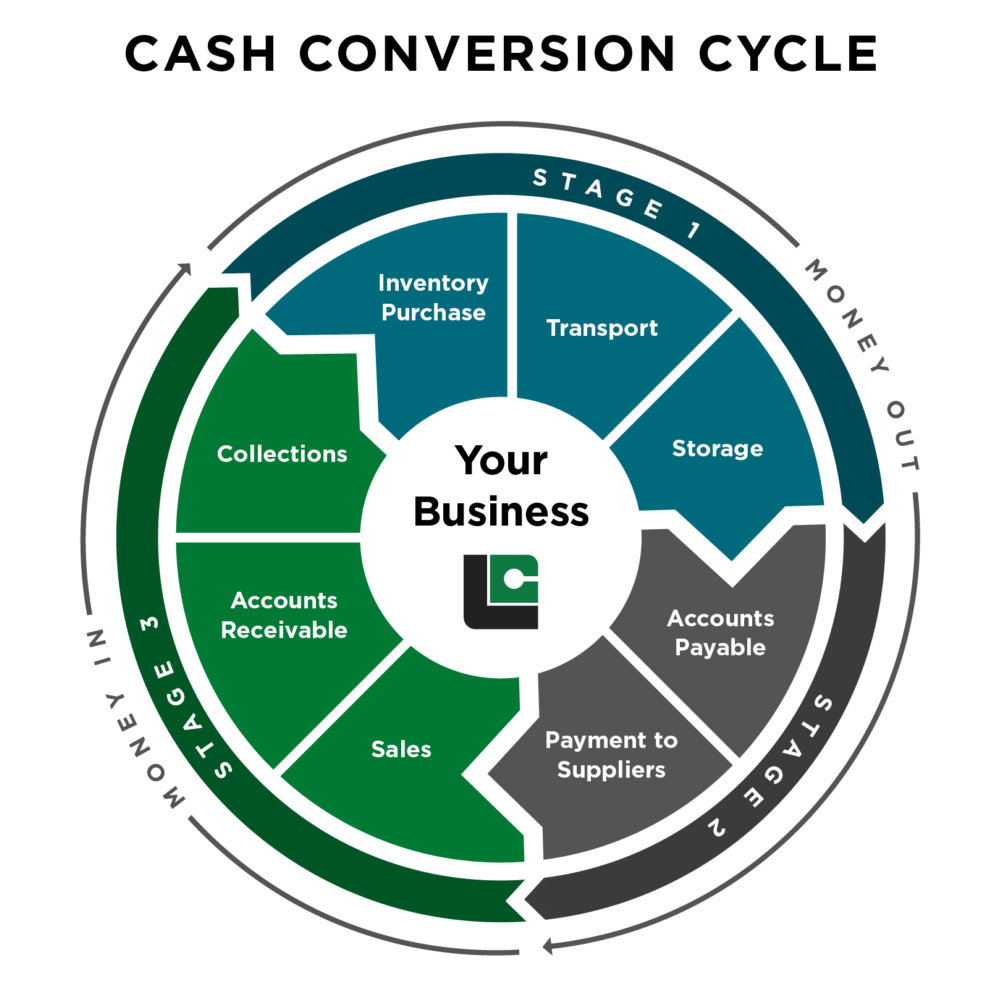
Your company’s cash conversion cycle (CCC) tells you how many days it takes to turn your inventory purchases into cash. It’s a cycle that is all too familiar: you acquire inventory from a supplier, store that inventory, sell it to a customer on account, pay your suppliers and collect on your invoices — thus getting paid and putting cash back into the company.

The CCC is an important financial indicator of your company’s cash flow. It shows your ability to maintain highly liquid assets and is a metric that lenders and other finance providers will use to assess your potential risk level.


Follow all six steps to becoming «lender friendly» and get prepared to access funding from any lender.

Access the complete eBook.


It’s not magic, it’s just math

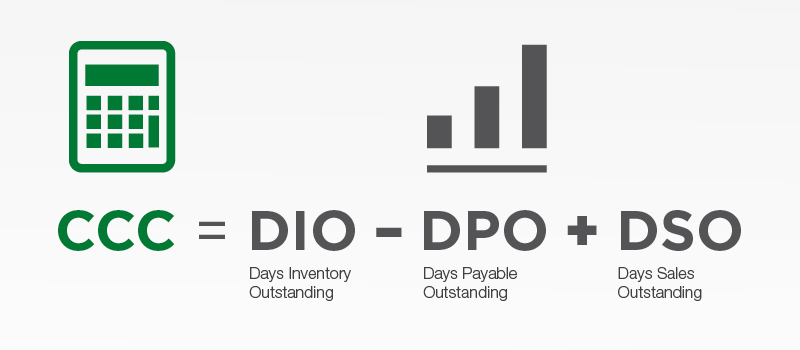
You don’t need to be a magician to unlock the power of the CCC formula for your business. All you need are three figures to complete the basic CCC formula, all of which you can find in your financial statements. 

cash conversion cycle formula

Let’s look at each component a little more closely.

  • DIO: Days Inventory Outstanding
    • This is the number of days on average that your company turns your inventory into sales. The smaller this number, the better.
  • DPO: Days Payable Outstanding
    • This is the number of days it takes you to pay your accounts payable. The higher this number, the longer you can hold onto cash, so a longer DPO is better.
  • DSO: Days Sales Outstanding
    • This is the number of days you’ll need to collect on the sales of that inventory after the sale has been made. Again, the lower the number, the better.

So the CCC is equal to the number of days it takes to sell your inventory, plus the number of days you need to collect on your sales, minus the days it takes you to pay your vendors.

Example: 
Keisha runs a PPE manufacturing company. Keisha always pays her suppliers within 30 days. She keeps enough inventory on hand to satisfy 60 days of sales and is good at managing this. It will take 52 days on average for her customers to pay their invoices.
This would be her CCC formula:
CCC = 60 days – 30 days + 52 days
CCC = 82 days
Keisha’s CCC is 82 days, meaning that she will need on average 82 days of working capital to convert purchased inventory into cash.

The above is a simplified example, and to get accurate results you must calculate and track your DIO, DPO and DSO on a monthly, quarterly or annual basis, along with the dollar values for inventory and sales.


“Our Liquid Capital Representative is more than just a lender — he’s a built in consultant.”
Nick Newman, Co-owner, Ridgeline Manufacturing


How the Cash Conversion Cycle reveals hidden potential  

Cash Conversion Cycle potential

Now that you have gathered the necessary numbers and ran them through the CCC formula, you will have a good indication of your cash liquidity position — and it can point your attention to what is helping or hindering your cash flow. Depending on the results, you may determine immediate areas that can be improved.

The longer the CCC, the more working capital you’ll need to manage your operations. And that can be an overwhelming challenge for many businesses. Generally speaking, companies want to shorten their CCC.

To shorten the CCC, you may be able to manage inventory levels better, get longer supplier payment terms, improve your collection process or adjust the payment terms you give your customers. However, this may not always be practical or something you’re wanting to change for a number of reasons.


“Liquid Capital allows me to operate without stress. If a company is offering early payment discounts, factoring is a cheaper option to gain access to money.”

Dave Kip, CEO of Best Broadcast


Making adjustments that fit your business

Choosing to use an alternative financing solution such as Invoice Factoring can help to lower your CCC by turning accounts receivable into cash faster.

Calculate cash conversion cycle

Factoring can help to lower your DSO which means that you will get paid on your sales faster and have quicker access to working capital. This cash can then be reinvested into your company faster than if you had to wait on outstanding invoices to be paid out according to the usual payment terms.

Or you could get extended payment terms from suppliers to reduce the DPO portion of the formula or use financing tools such as Purchase Order Financing to help you make up the gap where suppliers are not providing adequate or any terms. By extending the number of days you have to settle your accounts payable, you can keep cash in the company and effectively increase your working capital.

However, the CCC alone cannot be a complete indication of liquidity. You’ll need to look at calculating other liquidity metrics like the current ratio and quick ratio to paint a complete picture. You may already have these calculations in place, but if you haven’t yet calculated your cash conversion cycle, it’s time to start crunching the numbers and tracking changes over time to manage your business better.

Reducing your DSO and DIO or stretching your DPO are also useful tactics that can help your cash conversion cycle to grow your business. Do you work in an industry where “inventory” doesn’t apply? There are also other ways that you can use the CCC.


Keep reading our four-part cash conversion cycle series: 

Part 2: Learn about the 7 proven cash flow tactics every CFO and finance pro needs to know.

Part 3: Learn how to leverage your assets to grow your working capital

Part 4: Learn how to keep suppliers happy and cash in your pocket


Want to learn more about how invoice factoring and alternative funding solutions from Liquid Capital can help? Contact one of our Principals today

Develop a business plan for your new venture. Let Liquid Capital help guide your steps.

Developing a business plan for your new venture

Do you have an idea to evolve your business or maybe even starting something brand new? Turning your vision into a reality requires developing a business plan. Here’s how to get started.

developing a business plan
Image via Unsplash

Many people are waiting for all the stars to align before taking the next leap in their business or starting an entirely  new company. Because of that hesitation, they never get around to fulfilling their dreams. But by getting rolling on developing your business plan, you can turn your dream into a reality faster. 

In 2022, industries will continue to shift in new ways, and now may be the perfect time to take your project to the next level. To get started, it’s important to know what is involved in venturing into new territory or starting a business, and that’s where a business plan comes in. 

Why is developing a business plan so important?

A business plan is a formal document that provides the roadmap for your company. It can help you navigate through tough decisions and can help you manage any challenges that may come your way. It will also help you stay focused on your end goal as you grow your business. And if you are starting a completely new venture, it’s essential to have one in place before applying for funding or securing partners. 

To create a great business plan — whether for your startup, scaling business or mature enterprise — you’ll want to start with these steps:

Step One: Define your business goals

The first step in creating your business plan is determining the direction of your business (if you’re evolving into new territory) or what kind of company you want to start — along with your overall goals. For example, will you run a physical store, or do you prefer an online business? Do you want to sell a specific product or focus on services? Maybe you already have a hobby that you want to turn into a business, or you have an idea of an innovation you can bring to the market?

Once you define your ultimate goals, you’ll be able to start thinking about how you want to achieve those goals.

Step Two: Evaluate your business skills and knowledge

Many new business owners find it helpful to take classes in business to better grasp the intricacies of running a business. Online universities offer convenient solutions for those seeking to learn more about leadership, strategy, operations and general management.

If there are some areas of running a business that you aren’t well-versed in, you’ll want to leverage outside help or software that fills in the gaps. For example, if you’ve never managed payroll, software or apps can help. Many of these services provide same-day direct deposit, automation for payroll and payroll taxes, and time tracking.

Tired of waiting 90 days for payment? Try this instead.

Step Three: Define the structure of your business

Next, you’ll want to clearly define the best business structure for your venture. Incorporating rather than operating as a sole proprietorship does have its benefits. For example, if you form an LLC, you could be eligible for certain tax incentives, tax credits and business incentives. 

You will need a clear idea of what products you will sell at the time of the company launch and how your offering will evolve with time to keep up with industry trends and client demands. You will also need to know if you will be selling directly to consumers, acting as a wholesaler, or offering a B2B service for other businesses.

Step Four: Get your financials in order

An important part of creating a business plan is planning out the financing aspect. What cost structure will allow you to create your product or service and have it reach your final consumer? This would include all the physical production costs, supply chain, marketing, and personnel costs for your company structure.

Once you have all of the above information, you can bring it all together. Make financial projections of what your sales and profits would look like over the first few years and what startup costs and cash flow you need to finance to start the business.

Access to funding will be crucial in getting your venture up and running. Invoice factoring can help build working capital. 

Step Five: Research the market

The final step in creating a business plan is to research the competition. This will help you to avoid starting an unnecessary or unprofitable venture. Think of ways that make your company unique from other similar companies who are also competing for clients in this space. Answering the following questions will help guide your research:

  • What is different about your products and services that only you can provide?
  • Based on your product, costs, customer target, and competition, what would be the optimal price points for each of your products or services? 
  • How are you going to reach your consumers and let them know about your products? 

There are many resources online today that can help you establish a solid business plan. And once you have it on paper, you will see that it makes your vision come to life and gives you a base document that you can work with to approach investors or potential stakeholders in your business.


Up next: Create a smart digital marketing plan on a budget

relationship building is key to a successful team - let Liquid Capital show you how to carry this out!

Turn your sales team into relationship-building rockstars!

Give your sales team a winning advantage by boosting their relationship-building skills in the Relationship Economy.

relationship building


Not long ago, things like price, convenience and savings would drive customer preferences. But as we’ve moved towards the Relationship Economy, consumers are increasingly prioritizing customer service, brand loyalty and personalization.


“In a Relationship Economy, the primary currency is made up of the connections and trust among customers, employees, and vendors who create significantly more value in what we sell. These relationships and connections help make price irrelevant.”

John R. DiJulius III, The Relationship Economy: Building Stronger Customer Connections in the Digital Age


Understanding the relationship economy

In today’s world, consumers are inundated with choices. In the relationship economy, consumers narrow their options by considering which business cares about them as a customer—and which businesses will deliver the best experience. Customers may also choose to do business with companies and brands that most closely align with their personal values, as they are increasingly prioritizing customer service, brand loyalty and personalization.


86% of customers believe that their experience is just as important as the actual product or service they purchase. — PWC


As a result, the relationship economy is the idea that today’s consumer prioritizes personalization, rapport, brand loyalty and customer experience over factors such as price, discounts or savings.

And thanks to things like increased connectivity through social media and improved customer data, the shift from the consumer economy to the relationship economy has only accelerated. Companies that have a system to tailor and personalize their customer experiences are more likely to win customers and retain their business. 

customer service and relationship-building

This also means that sales prospecting needs to consider things like rapport, loyalty and relationships to build trust and credibility with their customers. Sales reps need to know how to prospect with these values in mind so they can build relationships and rapport with potential clients. 

Beyond happy customers, positive customer relationships can create ripple effect benefits, including improved cash flow, business growth, and overall brand trust and credibility.


Up next: Read The beginner’s guide to sales prospecting in the relationship economy eBook

Can’t get a bank loan

How to grow a business when you can’t get a bank loan

Can’t get a bank loan? You’re not alone, and you have more options when trying to fund your business growth.

Can’t get a bank loan

Photo by Jopwell


Startup capital is the number one obstacle to starting a business and then growing it to new heights. Getting a bank loan is difficult without a proven business history that shows your creditworthiness—and draining your savings to start a business is a risky move.

If you can’t get a bank loan, there’s no reason to abandon your entrepreneurial dreams. Here are three strategies you can use to start a business and grow it with limited working capital.

Start a low-cost business

Some businesses require five figures to launch, but there are a lot of businesses you can start without a major investment.

  • Online businesses are among the cheapest to start. Examples include selling virtual services, creating digital products or starting a no-inventory eCommerce business using dropshipping and print-on-demand services.
  • If you prefer to keep it close to home, look to local services businesses like pet care, lawn care or cleaning services. Think about how you might scale those into bigger operations, and you could take a traditional small job and turn it into a bigger business operation! 
  • Freelancing businesses are another top choice for first-time entrepreneurs. You can start a freelance business on the side or full-time using online marketplaces to build your client roster.

Your choice of business entity affects the costs of starting a business. Corporations come with additional startup costs but could be the right choice for your structure. While sole proprietorships and LLCs are inexpensive to form, they also come with limitations, so it’s important to consider the pros, cons and get professional advice on the route to follow.

Find business investors

What if you have lofty business dreams but lack the capital to make them a reality? When you have a great idea but no money to get it off the ground, turn to investors.

  • Angel investors and venture capitalists are two major sources of equity funding for startups. This type of investor is often suited for high-growth startups with the potential for large returns.
  • Startup accelerators help new business owners connect with investors. Some business accelerators provide capital directly to startups, sometimes in exchange for equity.
  • Many small startups find success with crowdfunding. The best crowdfunding strategies offer equity or non-financial rewards in exchange for contributions.

Apply for alternative financing

Business loans aren’t the only way to finance your venture. These financing alternatives appeal to entrepreneurs who can’t get traditional business loans or bank funding. 

In many cases, alternative financing can be leveraged alongside your traditional funding, and at Liquid Capital, we’re happy to work with your banker, traditional lender and other financial institution. Essentially, we become your funding team, which can supercharge your financing abilities.

  • Peer-to-peer lending uses unsecured personal loans through P2P lending platforms to provide startup business capital. Because P2P lending isn’t FDIC-insured, it’s important to understand the risks.

  • Equipment financing helps founders buy equipment without the barriers of traditional bank financing. Because the business equipment serves as collateral, you may not need credit history to qualify.
  • Early-stage businesses can maximize growth using invoice factoring. Invoice factoring turns unpaid invoices into cash to free up working capital.
  • When all else fails, bootstrapping is a proven way to build a business from the ground up. Instead of relying on outside funding, bootstrapping grows a startup slowly using its own funds.

Of course, we don’t want you to struggle to get funding, so give us a call and we can walk through all the options with you.


Scaling a business?

You don’t have to choose between draining your savings and giving up on your business goals. With the right strategy, you can start a business without putting your personal finances on the line. Use these resources to learn more about your startup financing options and discover your business’s path to success.

Up next:


returning to the office

Returning to the office won’t be easy. How can leaders support employees?

As employees begin returning to the office, there are some key considerations that leaders will want to address so their employees are supported.

returning to the office

Going back to the office and back to “normal” is a hot topic around the virtual water cooler these days. But as company leaders finalize their re-entry plans after more than 18 months of remote work, they face a cold new reality: The workplace as we knew it is no more. 

Even though socially distanced employees miss engaging with co-workers in person, many are reluctant to return full time. Research from Leger found that 33% of Americans and 40% of Canadians want to work a hybrid model, meaning a mix of in-office and at-home work. In addition, about half of Americans (47%) and Canadians (50%) who want to return to their workplace wouldn’t be comfortable doing so if some of their colleagues aren’t vaccinated. 

To help ensure successful re-entry, here are several ways to support your employees and teams when getting back to the office: 

Physical health and safety is job number one

Even as public health measures surrounding the pandemic lift, you can take steps to reduce health risks (and any associated fear factor) in your workplace. Guidelines to help stop the spread of the virus include implementing a rapid testing and screening program, providing personal protective equipment, and working with a building operator or HVAC specialist to improve air exchange rates or filtration. In the McKinsey study, improved air filtration was a top request among employees, with 62% saying it could decrease the stress they experienced from returning to work.

Put yourself in employees’ shoes

Just as employees had to acclimate to a new way of working when the pandemic first hit, the return to office comes with its own set of adjustments and challenges. For example, in a recent McKinsey survey, one-third of respondents said the return to work has had a negative impact on their mental health. Among those who have not yet returned to their workplace, nearly half anticipate negative mental health impacts such as stress and anxiety.

Create policies

A vaccine policy might also help ease employees’ minds. A survey by EY found that 61% of employees want their company to require the vaccine before returning to physical workspaces. For employees’ part, encourage them to stay home when they’re sick, practice hand hygiene, clean and disinfect their workstations, and maintain physical distance from co-workers.

Create an environment of psychological safety

In addition to making sure your employees are physically safe, it’s important to prioritize psychological safety. Psychological safety refers to the feeling of being one’s whole self at work, and the belief that one can speak up with ideas, questions or concerns without fear of negative consequences. 

A Workhuman survey of U.S. workers found that only 26% felt psychologically safe during the pandemic and experienced higher levels of burnout, stress and loneliness. 

Some ways you can boost employees’ psychological safety are showing appreciation for their ideas, being an active listener, fostering a culture of openness, and creating a sense of belonging.

Consider pay transparency

Most employers don’t want their employees to compare paycheques, as it can result in animosity and resentment among their teams. However, the concept of pay transparency is gaining momentum, as it aims to close unfair pay gaps based on gender, race, age or disability. While this might not be for everyone, it could be something to consider for some organizations.

Pay transparency allows your company’s compensation figures (salary ranges or specific numbers) to be visible to other people, either internally, publicly, or both. 

While pay transparency encourages equal pay, there’s more to it than monetary benefits. When done correctly, pay transparency can improve workplace culture, promote diversity, boost morale and improve employee engagement. Some pay transparency tips are: 

  1. Review compensation models and resolve salary discrepancies
  2. Determine your company’s comfort level with pay transparency
  3. Train managers on how to successfully navigate salary discussions.


Once you’ve reviewed these considerations, you will want to create a clear and transparent return to the office plan. Sharing your plans with employees will help to reduce anxiety and uncertainty about what awaits everyone as they transition into the post-pandemic workplace — whether they return in-person full time or take a hybrid approach.


Up next: 7 ways to make strong business relationships that last