
Notebooks and group of business people shaking hands

Improve Your Financial Skills (With Free Premium Online Courses)

Improve financial skills

All business owners are finance experts, right? For some, yes. But for many, this is a lifelong learning experience. There is always more to learn, and everyone can agree that it’s a necessity to constantly improve your financial skills. After all, your competition is going to be doing just that.

However, you might also be laser-focused on other priorities, and financial education has been pushed lower on your list. How can you spend less time (and money) to improve your financial skills?

No problem.

Improve your financial skills by taking advantage of these five online resources and accreditations. Once you top up your skills, you should also show them off and update your LinkedIn profile and resume. And the best part…these courses are all inexpensive or free.

1. LinkedIn Learning – Finance & Accounting

LinkedIn Learning

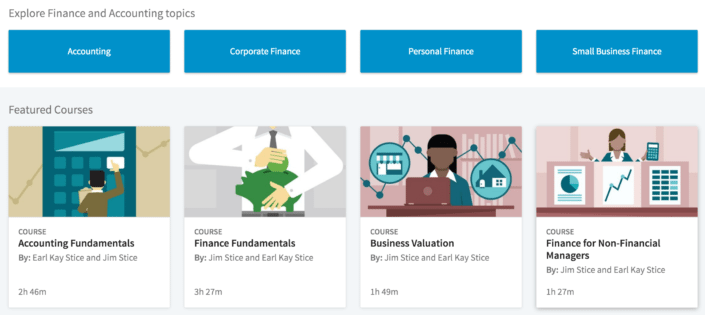
LinkedIn recently purchased famous training site Lynda.com to beef up their LinkedIn Learning platform. Their “Finance and Accounting” section includes courses in corporate finance, small business finance and accounting, all designed for you to start with the basics and work your way up to more advanced topics. Learn about financial analysis, bootstrapping businesses, income tax planning, personal finance tips, managerial accounting and creating KPIs.

Cost:

  • One month free trial, then $20 – 30 per month to access 1000+ business courses.
  • Annual subscriptions available.
  • Bonus: If you’ve subscribed to LinkedIn’s Premium membership, you already get LinkedIn Learning access for free.

Benefits:

  • Stay on top of current trends in finance and a variety of other fields
  • Learn outside the box: Brush up on marketing, sales and operations.
  • Be more efficient in your job, whether that’s interviewing employees, building spreadsheets or persuasive selling.

Format:

Video content makes up the majority of this site.

Time commitment:

  • Courses range from 5 minutes to 20 hours.
  • Take it at your own pace: Start a course and LinkedIn Learning will hold your place until your next login.

2. MOOCs – University Level Finance
MOOCs

Yes, it’s a weird name, but it’s also incredibly valuable.

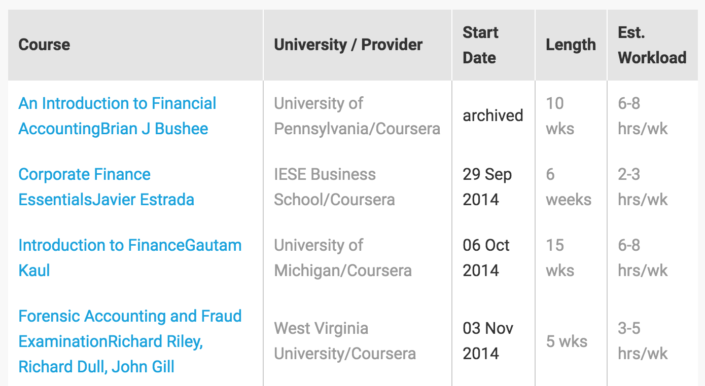
MOOCs are Massive Open Online Courses, and include university courses from reputable institutions that have been posted online, complete with lecture notes and quizzes. Outside of attending university in person, this is an incredible resource for learning.

Check out this list of finance courses from institutions like the Yale, Stanford, MIT and Caltech.

Cost:

Many courses are completely free, with a paid option for verified certification.

Benefits:

  • Get a university level education for free.
  • Stay ahead of the curve, and the new competition that will be hitting the job market.
  • Access educational resources in other cities and countries.

Format:

Downloadable course materials, streaming video, audio clips and resource pages.

Time commitment:

  • Aim for around 6 hours per week and 8 weeks on average per course.
  • Each course displays the number of weeks and hours per week needed to complete.

3. Hootsuite Academy – Social Selling & Networking

Hootsuite Academy

As a business pro, you’re likely already a great networker, but it never hurts to brush up on your social networking skills.

The Hootsuite Academy offers a variety of beginner and intermediate social media courses to get you up to speed and in the groove when it comes to online networking. Learn how to optimize your social media profile, grow your followers, publish the right content and use advertising to connect with new customers.

As an added level of education, you can enrol in the Hootsuite Social Selling and Certification to obtain your status as a “Certified Professional” in social selling. “Hootsuite’s course on Social Selling teaches Sales Professionals to leverage social media to save time, drive a larger number of better-qualified leads, and increase deal sizes.”

Cost:

  • Hootsuite platform and social marketing training are free.
  • The social selling course costs $299.

Benefits:

  • Improve your social networking skills.
  • Proactively find new clients with the right conversations.
  • Be discovered more easily by prospects.

Format:

Short videos, articles and interactive quizzes.

Time commitment: 

4 – 8 hours per course.

4. Google Analytics Academy – Digital Analytics
Google Analytics Academy

If you have a website or blog and want to learn more about who visits your site, why they visited and what they did on your site, then you need to know Google Analytics.

The simplest way to learn is through the Google Analytics Academy that offers training in every aspect of the platform. With four official courses to choose from, you can learn about the digital analytics fundamentals, the Google Analytics platform itself, e-commerce data decision-making and how to use Google Tags properly.

Google is about to launch revisions to their programs, offering even more incentive to get cutting-edge training. In the past, you could also obtain certifications for completion of your training, so keep an eye out for that to return.

Cost:

Free

Benefits:

  • Get advice and lessons directly from Google’s experts.
  • Improve your online discoverability.
  • Understand who your customers are and why they are (or aren’t) finding you online.

Format:

Videos, transcripts, quizzes and blog posts.

Time commitment:

Set aside 6-10 hours to properly complete each course.

5. Alison – Financial & Economic Literacy

Alison Finance

Alison offers a similar formula training to LinkedIn Learning, but all of their courses are offered free of charge. On the downside, you’ll have to watch brief ads before each course module, but they aren’t that obtrusive.

In return, you get access to a wide selection of course – in particular, check out the “Finance” section. The strength of these courses lies in their plain English approach so you can understand and retain the knowledge. They also offer study groups for those who like to learn alongside others.

To cap it off, they also offer certifications and Alison diploma courses.

Cost:

Free

Benefits:

  • Real-world terminology.
  • Join or create a group of like-minded learners to study together.
  • Community hub provides extra motivation & success stories from Alison students.

Format:

Videos, slides, animations, interactive quizzes and assessments.

Time commitment:

Courses can range from 1 – 10 hours.


Daily learning can be a challenge, faced with time constraints, high costs of continued education and difficulty finding great courses or expert trainers. By starting one of the above online courses, you will hopefully find the motivation and material to improve your financial skills without cutting too far into your schedule or budget.


 

Time management tips

Need more time? Get these 5 quick time management tips

Time management tips

Whether you own your own business, freelance or work for an employer, your productivity often carries significant weight in your career and income success. Learn to maximize your schedule each day, and achieve your goals with time management tips.

The following is a look at five of the most important time management strategies to reach your highest daily productivity levels.

1. Prioritize High-Value Tasks

Successful professionals are usually creative people with vision. If that’s you, it’s likely that you want to accomplish more each day than time and practicality allow. Sound familiar? There’s an easy escape, and it’s relatively simple.

Step one is to prioritize critical tasks in your calendar, which helps you achieve the greatest benefits from the time you do have. As you contemplate which tasks to rank at the top of your list, focus on the impact to your bottom line and your personal satisfaction. Ideally, spend more of your time on high-value tasks that you give you great personal satisfaction when you complete. Then delegate the smaller and less enjoyable activities, or figure out ways to eliminate them altogether.

2. Minimize Your To-Do List

A to-do list is an important time-management tool because it helps you identify tasks and create an order for their completion. To streamline your workday, complete the quick and easy tasks right away to avoid building up your list. As soon as you cross a couple lines off your list, you’ll be mentally in the groove to keep going. Then start to tackle the bigger items by aiming for at least one major task before lunch and one after.

But a word of warning – don’t get too carried away with the small tasks. From a psychological standpoint, piling little items on your day increases the likelihood that you will feel overwhelmed. If it takes almost as long to record the task than it does to do it right away, just cut to the chase and get it done immediately.

Related: Learn 21 ways to get more accomplished every day.

3. Plan Ahead

Know what you want to accomplish at the start of each workday. Depending on when your mind works best, you could start your morning early or prepare your to-do list at the end of each day.

If you try to think of things to do one at a time, you slow down your productivity because you aren’t able to ramp up to full speed. Instead, use a tasks list in your email software like Outlook tasks, or try an online task list that syncs with your phone and tablet, like Any.do or an even more robust platform such as ClickUp.

4. Include Your Breaks and Non-Work Activities

Finding balance in your daily schedule is an important, often overlooked factor in entrepreneurial efficiency. This point is especially true if you work from home. Integrate your work, individual and family responsibilities into your plan.

Specific to your work regimen, plan in time for breaks so you aren’t stuck at the desk all day. Taking periodic breaks to move around and refresh yourself helps you sustain adequate energy. Scheduling rests helps keep you fresh and mentally looking forward to breaks in the day, as opposed to developing a tendency to routinely distract yourself from work that needs to be completed.

5. Turn Off All the Notifications

Ever catch yourself reaching for your phone with no real purpose? Our phones have turned into the biggest distraction and time vampire of the modern age – and the constant notifications aren’t helping.

It’s time to cut them from our workday. That means turning off or muting any non-critical app notifications like Facebook, Instagram, games, weather and sports updates. Without the constant pings telling you about a friend’s status update, the latest scores and reminders to play your daily Lumosity game, you’ll be less inclined to check your phone and then waste more time staring at your screen without a purpose.

Business critical apps and functions like your email, calendar, Slack, text messages, phone calls and even What’s App (if you use it to collaborate with team members) can be left on so you don’t miss out on important events and conversations. But cutting the mental clutter of all the countless other notifications will help you break away from that phone addiction.

Bonus tip: Schedule your tasks and stick to the plan

If you’re a natural planner, you’ll find this tip very easy to stick to. However, if you’re struggling with time management, odds are you’re likely to benefit from having a predetermined schedule. You can start by writing down your tasks, block time to work on them, and get cracking.

These agenda and schedule templates from HubSpot will help you organize your commitments, meetings, employees’ schedules, and skyrocket your productivity.

Time Management Tips Take-Away

Take the time to implement these five primary time management tips into your daily routine and you’ll be amazed at the difference in what you can accomplish. New habits take as much as three weeks to become part of your natural routine and prove effective. But you will never regret working hard at improving your time management and productivity.

Grow your business, satisfy your clients or employer, reach your professional goals and earn optimum income.

Stairs

7 Important Steps That Will Improve My Business Credit

improve business credit steps

Capital is essential for any business, but sometimes our commercial credit becomes unhealthy. Unfortunately, when a commercial credit rating isn’t perfectly clean, sourcing a small business working capital loan or another form of finance isn’t always straightforward. You might be asking yourself, “So what exactly can I do to improve my business credit rating?”

Every savvy entrepreneur must smooth the peaks and troughs of revenue to keep up with payroll and inventory, while also financing growth toward future success. For most enterprises, this means accessing business funding from time to time rather than relying on reserves, whether this credit is taken through mainstream banks or alternative finance.

     Did you know? Factoring funding is NOT based on your credit rating. Learn now.    

To increase your chances of getting credit at an affordable rate, it pays to take steps to improve your business credit — and it’s simpler than you might think. Here’s what to do.

1. Get Your Books in Order

If you’re looking to obtain a new line of credit in the near future, it’s important to first assess your situation and then proceed with a little caution. Each credit application you make will be recorded on your file, and multiple rejections will count against your score.

If you’re looking to obtain funding in the near future, it’s important to first assess your situation and then proceed with a little caution. Each credit application you make will be recorded on your file, and multiple rejections will count against your score. Applying for a credit card can actually hurt your credit score, so it’s important to be strategic about it.

Before applying for any funding, spend some time getting your finances into good order, researching your options, and finding a credit source that’s likely to approve your application.

2. Separate Your Business Identity

When building your business credit rating, it’s essential to establish a business credit identity distinct from your personal rating.

If you’ve not already incorporated your business, then consider doing so, and also obtain a federal tax ID number (EIN in the U.S. or a BN in Canada) or equivalent registration. Make sure all your bank accounts and credit cards are in your business’s legal name, and that you don’t use any personal accounts for business purposes.

3. Build Your Profile

The three major business credit reference agencies keep their own files, and it’s important to ensure your profile with each is complete and accurate. Check that ExperianEquifax and Dun & Bradstreet all hold the correct details about your business, and that all your active trade lines are recorded on your file.

If you have any longstanding credit accounts with suppliers, add them as references on your profile. Even if they don’t actively report to the agencies, your good records with them will be taken into account. Going forward, regularly check your file for any errors, omissions or signs of unknown activity.

4. Arrange Credit With Suppliers

Each bill you pay on time will give a small boost to your business’s credit score, and you can increase this effect by paying bills early whenever possible. Even better, if you establish credit lines with your suppliers and stick to the terms, each transaction will add a positive to your credit profile.

5. Avoid Signals of Financial Distress

As well as being conscientious about paying bills promptly, you should avoid showing any signs of financial distress that could lessen your creditworthiness. Filing accounts and paying taxes on time will give your rating a boost, while paying down debts and avoiding using credit for routine expenses will send signals of stability.

Related: How to get start-up financing without a bank loan.

6. Cut Back on Credit Usage

Whenever you’re looking to obtain a major new line of finance, you should aim to present a picture of clean credit activity within your current circumstances. Ideally, your ongoing level of credit utilization should be no more than 30% on each account your business holds. Try and avoid unnecessary spending on credit or building up balances. You should also pay down what you can — and clear your borrowing each month when you do spend on an account.

7. Consolidate Accounts

If you have credit card accounts with zero balances, it may seem a logical choice to close them down and simplify your business’s financial situation. However, if you want to boost your credit rating, the smarter choice is to keep these accounts active so long as they’re in good standing.

Closing an established, zero-balance account will remove positive history from your file, worsening your rating. Instead, take the opportunity to balance any debts across multiple accounts, so that each has no more than the all-important 30% utilization of its credit limit.

Few businesses can be totally self-sufficient. However, accessing business funding doesn’t need to be expensive or complicated. Taking a little time to improve your business credit rating will make obtaining commercial credit easier and more cost-effective, leaving you free to concentrate on driving your business forward.

Smiling businessman

6 Body Language Mistakes You Might be Making & How to Fix Them

Posture Perfect: Are you unconsciously sending prospects the wrong message? Here’s how fixing your body language mistakes can help you win more opportunities.

Body Language Mistakes

As salespeople, we often focus on our pitch and the carefully selected words we use when speaking with prospects, but what about our body language? Are we making major body language mistakes that are holding us back from closing more deals?

55% of effective communication comes down to body language mistakes

A famous study by UCLA Professor Albert H. Mehrabian found that only 7 per cent of effective communication actually comes down to the words we say. 38 per cent comes from the tone of our voices, and another 55 per cent depends on our body language.

How we stand, where our eyes look, our hand gestures and even subtle movements can all make a difference in the interpretation of our sales pitches. But the most effective communicators will combine all three parts: the words spoken, the tone of voice and the body language.

Related: Do you have this powerful leadership skill?

The professional sales training team at Sales Grail explains that a sales person’s body language can immediately spark customer engagement. “What we mean by posture is not a cocky guy with his feet up on his desk — this is just rude and it suggests a lack of humility in one’s leadership and sales approach. Rather, by posture, we mean one of openness and confidence.”

When genuine, that confidence can help you develop a stronger connection with the prospect, as they describe. “When we’re really behind something, we become an amazing combination of characteristics. We’re relaxed, yet passionate. We’re calm, yet excited. We’re understanding, yet persistent.”

Here are six body language mistakes you might be making, and how you can turn your visual communication and body language into a sales secret weapon.

Mistake 1: Slouching — especially while on the phone

You’ve likely heard that sitting is the new smoking, but has that made you get out of your chair more? At the very least, have you sat up a little straighter when seated? This is one of those body language mistakes that we’re likely all guilty of doing.

“Research has shown that sitting in a slouched position can send “sad signals” to your brain. You are more likely to produce cortisol, a stress hormone, and experience negative thoughts when you slouch. Slouching also can make you feel disempowered and weak compared to the people you’re interacting with – whether in person, on the phone, or even over email.” – Tech.co

Mistake 2: Too little (or too much) eye contact

“It’s good to maintain eye contact 70% to 80% of the time. Any more and you might appear threatening, any less and you may appear uncomfortable or disinterested.

Good eye contact exudes confidence, engagement and concern. Plus, it’ll help you read your customers’ emotions and body language.” – Customer Experience Insight

Mistake 3: Never “power posing” before meetings

“Breakthrough research from Professor Amy Cuddy at Harvard Business School…proves that body language and body positioning directly impact self-confidence and feelings of power. … Professor Cuddy’s research indicates that a salesperson (or anyone about to go into a stressful situation) should assume a high power pose for at least two minutes. Rather than hunch over an iPhone, a salesperson should find a private place to spread their arms and pull their shoulders back.” – Fast Company

Mistake 4: Dressing to blend in, not to fit in

“First impressions get set in stone very quickly. And, like it or not, the way you look is the most important factor in shaping those first and lasting impressions.

“The key is to always dress well enough to fit in with the top people you’re calling on, yet never to blend in with the wallpaper. Think of your clothes as the way you package yourself. Always dress in a way that creates the maximum positive impact on the people you want most to impress – your customers.” – Selling Power

Mistake 5: Talking too much with your hands

This isn’t to say that you should completely stop hand gestures. They are an important part of getting your message across and creating dynamism and charisma in your communication. But overdoing your hand movements can be a distracting body language mistake that can have an undesired effect.

«Avoid chopping gestures … Whole arm karate chop gestures can psychologically cut up the space between you and your interview in an aggressive way … Pointing is often perceived as an aggressive motion and in some cultures is considered incredibly rude. … Any fast, repeated or aggressive hand gestures should be kept to a minimum. … [Instead] you should appear open and approachable, which means your hands should be in front of you and ready to gesture naturally.” – Forbes

Mistake 6: Work the room

Whether it’s a presentation, speech or in-person sales call, making strategic physical moves could draw attention to the right discussion points.

“To bring movement to your speech, use the physical space you have available and walk it. For example, if you’re presenting three points, talk about point A when you’re at your first position; then move out 2 or 3 steps and talk about point B; this way, a movement that includes space will accompany your speech.” – HubSpot


Next: Get these 7 new school digital marketing tips to help grow your business.

Illustration - target

Can business failure make you successful?

Business failure leads to success

No one enjoys failing. When you’ve poured your heart and soul into an effort that crashes and burns, the pain can be excruciating. Yet business failure is a part of running a company at one point or another. So, should you find yourself down and out, focus on the upside. It will help you get back on track quickly, and with newfound strength.

Here are five reasons to dust yourself off and considering any failure a blessing in disguise.

1. It’s an education

Thomas Edison made 1,000 attempts at the light bulb before succeeding. You could say he had 1,000 failures, but with each attempt he learned something more. Following a “failure,” you’re better educated, better experienced and, hopefully, a bit wiser.

The same mindset can be seen in modern business, with much success. For example, at NerdWallet, a company offering tools and advice for managing personal financial decisions, failure is celebrated publicly on the “Fail Wall,” a space covered with Post-it notes memorializing the lessons learned.

Related: Even out the ups and downs of running your business.

2. It can improve investment opportunities

In Entrepreneur.com’s Celebrating Failure article, Jake Gibson notes one big reason to rejoice: “Many founders of failed companies find it easier to raise money for their second company because investors know they are buying experience and the lessons learned from those failed endeavors.”

Conducting a thorough post-mortem is on many a business guru’s short list of things to do following a setback. Collect all the insights and data you can. Learn where the missteps occurred — and how they can be avoided the next time.

3. It’s a bonding experience

When we fail, we often do it in the company of partners, colleagues and employees. They are all affected, and may suffer as much as we do. Let these people know that you value them and care about them. Don’t engage in blaming or any other form of divisiveness.

Focus on moving forward as a team. The shared experience can be transformative, providing for you to emerge from the setback as a stronger, more committed organization. 

4. It provides a determined focus

Jodi Goldstein, managing director of the Harvard Innovation Labs, is one of many experts advising that you not dwell on the past as you pick up the pieces following a failure.

“Don’t waste energy by constantly thinking about how you could have avoided the situation that you’re currently in. If you decide to continue with the venture, this means working to maintain high levels of morale amongst your team, celebrating each win that you achieve as you battle your way back into business.

«If you ultimately decide that you cannot, or don’t want to continue with your startup, it means taking the lessons that you learned to whatever you might do next, while not dwelling on what could have been.”

5. It’s never the end

Finally, remember that whenever you fail, you’re in good company. The most successful people on the planet have all been failures at one time or another. Consider your low point as merely the prologue to your next chapter.


Up next: Do you have the ultimate entrepreneur mindset?

Business agreement handshake

How to Find the Right Asset-Based Loan Partner

Business agreement handshake

For many businesses, asset-based loans can be the perfect solution when they’re short on working capital but don’t currently qualify for a traditional loan. The key is finding the right funding partner that is willing to learn about your business, understand your challenges, and then work with you to find the optimal solution that will offer the most benefits to your growing business.

Finding that right partner is a vital part of the funding process, especially when you rely on their expertise, products, services and connections. Nothing can roadblock a company’s operations like lack of working capital. With asset-based loans, in particular, you’ll be accessing larger amounts of capital while agreeing on terms that maximize the value of your available assets. Obviously, working with a trusted partner is crucial.


Background: Who should consider an asset-based loan?

Asset-based loans (ABL) allow companies to leverage their accounts receivable, inventory, and in some cases, equipment and real estate to access working capital. Qualifying companies generally have a strong credit rating and maintain comprehensive financial reporting with strong internal controls — tending to be established businesses with a solid track record.

     Related: Get the 101 on Asset-Based Lending here.


With many funding options in the market, how can you tell which one is right for your business? Below are three main factors to consider.

1. Find a like-minded partner

Your ABL funding expert should feel like a genuine partner in your business. They’ll need to understand your business model, industry challenges, opportunities, and any unique processes you have in place. A partner with an entrepreneurial mindset and personal experience as a business owner/operator could also add to their understanding of where you’re coming from and where you are going.

Also, look for funding partners who have cut their own red tape and complicated approval processes. These can slow down your ability to access cash flow when it’s needed — but be careful to ensure they are still credible and still have a strong reputation in the market.

Ultimately, a like-minded partner will work with you in the long-term and should go the extra mile to create more availability against eligible collateral. That means your assets will provide the biggest return for working capital.

2. Look for value beyond the “money”

Your ABL partner should be more than just a person that writes you a check.

Factor in various aspects of value beyond the capital they provide. With ABL, rates are generally competitive but on par with different vendors, so it’s important to assess other criteria that can show who you’re dealing with.

Look for service partners who will provide access to their referral networks that can extend your business relationships. This longer-term value is often overlooked but can be a strategic benefit. A trusted partner will also provide access to advice related to the struggles of a growing business, and they’ll be able to offer strategic business advice and beneficial tools as you grow the company. Their network along with access to like-minded entrepreneurs are invaluable to a business facing the challenges of growth and emergence.

3. Work with a person, not just a piece of software

Technology is an important aspect of modern business, but when it comes to a funding relationship, you should be working with a real person.

In particular, find local representation and experts who will be responsive when you have questions or challenges. Look for an organization with strong underwriting, risk assessment and good relationships within the industry. Your partner should also be able to work with you to offer creative solutions to your business funding needs.

With ABL, your company is going to be relying on the funding partner for large amounts of working capital, and this shouldn’t be trusted to a piece of software or website touting fast-funding without strategic consultation.

Regular day business work table with laptops and gifts

3 incredible business gift guides

Business Gift Guide

If your holiday shopping list is making you nervous, especially when it comes to clients and colleagues, don’t worry. We’ve got you covered with gift ideas for even the most hard-to-impress business pros in your life.

Part of being an entrepreneur or SMB owner is an understanding that balancing work and life can be demanding. Even if your office closes for a few days, business doesn’t completely stop for the holidays. For many of us, it gets a lot busier. Here’s hoping that this handy gift guide makes your festive season flow a little smoother.

Here are our top picks from three of the best gift guides around. Click through further to see the full lists and peruse their expertly curated suggestions. Best of all, most of these items are available on Amazon with just a few clicks — perfect for those of us on a tight schedule.

1. Thirty Boring Gifts Everyone Secretly Wants by Mashable

The tech bloggers at Mashable really nail it with this list of essential items that will get used all year (as opposed to ending up in the garage after January). Take for example Smartwool Socks, an All Purpose Kitchen KnifeRainbow Sharpies, a Fold Up Rain Jacket, and Noise Canceling Headphones. These make outstanding gifts for the kid in all of us.

2. Gizmodo’s Gadget Gift Guide

Comprised of “things we’re hoping to receive this season,” the tech experts from popular gadget blog Gizmodo assembled an incomparable guide for all the electronically inclined folks on your list.

Highlights include Outdoor Research Stormtracker Heated Gloves for cold weather outdoor enthusiasts, the quintessential Audio-Technica LP120 Professional Turntable for those looking to get serious about collecting vinyl, and the face-rejuvenating Clarisonic Mia 2 Facial Sonic Cleansing System.

3. Gifts for Entrepreneurs by celebrity Entrepreneur Tim Ferriss

Legendary angel investor, author, social media guru and podcaster Tim Ferriss shares his list of fantastic gift ideas for fast-paced individuals like himself.

Tim’s recommendations are broken down into helpful categories of under $25, under $50, and under $100. Highlights for us include the RAD Roller, which is amazing for rolling out tight muscles in the back, arms, and legs. The Sleep Master Sleep Mask is great for anyone who sleeps on planes or on irregular schedules. And finally the multipurpose casual/athletic shorts Ferriss swears by Myles Everyday Shorts.

Bonus: Other notable gift guides

These include one from The Atlantic for the impossible-to-buy-for, which they crowd-sourced from real readers. Refinery 29 has another very fun interactive gift guide for Moms, Dads, significant others and even your ‘work spouse.’ Generate a custom selection of gifts based on traits like chill, type A, early adopter and fancy.

A successful businessman

This Leadership Skill Can Unlock Growth and Profit

Can you be a super leader?

Leadership skills

“The top 10 companies on the Empathy Index increased in value more than twice as much as the bottom 10, and they generated 50% more earnings.”

How often do we attempt to understand things from someone else’s perspective? As an entrepreneur or small business leader, this skill is critical in human resources, but it also impacts your bottom line.

Empathy includes everything from how employees perceive you to whether customers are satisfied with your products or services. And while it’s often dismissed as overly “touchy-feely” or “wimpy and emotional,” practicing empathy is linked directly to financial gains, so ignore it at your own risk.

Why Empathy Drives Business Growth as Much as Solid Working Capital

According to the Harvard Business Review, empathy means understanding our emotional impact on others and making a change as a result. “It’s more important to a successful business than ever, correlating to growth, productivity, and earnings per employee,” HBR explained.

Need proof, check out the global Empathy Index, which analyzes the ethics, leadership, company culture, brand perception and public social media messaging of 170 companies listed on major financial indexes. Staggeringly, companies that performed well in “empathy” also had equally high overall business performance.

“The top 10 companies on the Empathy Index increased in value more than twice as much as the bottom 10, and they generated 50% more earnings (defined by market capitalization).”


5 easy steps for entrepreneurs to practice better empathy

empathy

Great business relationships, especially those involving growth capital and funding, start with a face-to-face understanding of the client’s needs, fears and goals.

As business partners, we’re always listening for ways to make our services more responsive. Renowned leadership advisors and empathy experts SYPartners recently published a list of 5 Ways to Cultivate Empathy, and it struck a chord. (This cutting-edge management consultancy also created an app called Unstuck that helps people understand what’s holding them back and how to move forward — it’s worth checking out.)

According to SYPartners, empathy enables leaders to “build stronger teams, design more ingenious solutions, and deepen their emotional intelligence, an increasingly covetable skill in the next era of business.”

Try their five proven ways of practicing empathy: 

1. Put down your guard.

“Your ability to feel emotions is what triggers them in others. If you want to connect with someone, you have to let yourself be vulnerable, too.”

ACTION ITEM: It’s easy to dismiss chitchat around the office, but sometimes these genuine interactions can take your business relationships to the next level. When someone asks how you’re doing, be real with them. Share a story from your weekend or a challenge you’re facing right now. SYPartners recommends starting your meetings with a “pulse-check” to invite your team to share what they’re excited or anxious about. By getting real with your colleagues, even for a moment before jumping into business, you’ll be practicing empathy.

2. Help others know they matter

“As Oprah often says: «Every human being is looking for one thing, and that is to be validated, to be seen and to be heard.» Your job as a leader is to help others know they matter.”

ACTION ITEM: In modern business, devices control our lives. Computers, tablets, smartphones and even smart watches. But they can also destroy our attention spans and ability to focus on the people around us. Can you go through an entire meeting without your gaze drifting to your screen? Often, that text or email can wait. When it matters most, give your full attention to the people around you — in face-to-face meetings, client conversations and critical moments with your staff.

3. Pay attention to body language

“Thousands of invitations for empathy cross your path every day. Do you notice them and shift your behavior, or do you let them glide past?”

ACTION ITEM: Your actions speak volumes, especially when you can pick up on subtle cues from your team’s body language — and then respond empathetically. In presentations, for example, notice how the room reacts to your comments. Pause to let key points sink in, allow curious minds to ask questions or shift your tone and topic if the message isn’t resonating. When you sense changes in your coworkers’ body language, these are visual reminders for you to acknowledge the mood and react accordingly.

4. Stand in someone else’s shoes

“It’s not always possible to get all the necessary voices at the table. But that doesn’t mean you can’t summon your imagination and best acting skills to pressure-test your team’s thinking.”

ACTION ITEM: True empathy comes from experiencing a situation from another perspective. SYPartners recommends that you take on personas in your next team meeting or workshop, assigning roles to each team member. By acting as skeptical customers, investors, competitors or a long-term client, they’ll be forced to take on those people’s characteristics — facing the challenges from a different point of view. You can also have the team interview these real people in advance to get a first-person perspective and immediate feedback.

5. Take a field trip

“It’s hard to get perspective when you sit at a desk every day. To better understand whom you’re designing for or collaborating with, go to them where they are and observe their routines.”

ACTION ITEM: Whether it’s a different team, department, office location or your client base, you’ll never get more first-hand experience than visiting where they work. Take your team on a “seeing exploration” to observe their environment, as SYPartners explains. Ask questions about how they operate on a daily basis, the major challenges they face, what they are proud of and even potentially how you can help out.

Business illusration

Learn This Quick Way to Take Advantage of Supplier Discounts

cash cycle

Sometimes you’ll come across a business deal that’s too good to pass up, but the payment terms are too short, or worse yet…there are no terms.

That’s the time when working capital is crucial, and there’s a quick solution to get you the necessary capital.

For instance, if your supplier network offers a limited-time bulk sale, you can take advantage of that deal with the Purchase Financing Program (PFP). This doesn’t tie up any working capital to finance the cost of the payment, so you can keep your day-to-day operations intact.

Who is the Purchase Financing Program made for?

PFP is a very attractive solution for companies that already have a strong credit rating but may have maxed out their bank loan options, or need a faster solution.

No matter where your supplier is located, your in-transit inventory can be financed. That inventory can be goods for resale, inventory or consumption. You receive the goods, then pay the PFP invoices as agreed. It’s that simple.

The Purchase Financing Program can effectively reduce your CCC by extending your purchase terms. If you have the ability to pay in regular terms, but not the short or no terms set out by the supplier, this program can help you.

Example: How PFP can lock in a great supplier deal

Jacksons Preserves, run by Meg Jackson, is a 30-year family-run business with excellent sales, suppliers, a dedicated customer base and a strong credit rating. It is currently quarter-end when Jacksons pays out many expense and payroll bonuses, and their main supplier has just offered a deep discount on an overstock of canning supplies. The catch? Payment is required on delivery (COD), and it’s first come, first served.

Jacksons holds inventory for an average of 14 days before shipment, has a standard net-30 day payable terms, and gets paid on average after 60 days. If they take the discount, they’ll be left tight on capital after also paying the bills.

Cash Cycle Reminder:

With this bit of information, we can calculate the “cash cycle” for Jacksons Preserves, which tells you how many days it takes them to turn their inventory purchases into cash. That number (known as the CCC) is one key indicator that lenders and other financial providers use to assess your potential risk level. Want to learn more? Get all the details and figures in part one of our cash cycle series.

How PFP works in this case

Jacksons calls up their Liquid Capital partner to use the Purchase Financing Program and snag this supplier deal while it lasts. Liquid Capital pays the supplier directly, deferring Jacksons’ payables outstanding for this transaction to 30 extra days, giving them time to gain working capital from other sales.

Here’s how the cash cycle calculations would look when comparing PFP to an ordinary situation. It’s quite a dramatic improvement.

ORIGINAL CCC USING THE PURCHASE FINANCING PROGRAM
CCC = DIO – DPO + DSO CCC = DIO – DPO + DSO
CCC = 14 – 0 + 60 CCC = 14 – 30 + 60
CCC = 74 days CCC = 44 days

Improved CCC by 30 days


In this instance, Jacksons Preserve will have an extra 30 days of breathing room to pay the expense on their supply deal. By taking advantage of the discount, their production expenses will decrease and profits will likely increase. This more than pays for their short-term financing solution.


More in the Cash Cycle Series:

Part 1: How to Determine Your Company’s “Cash Conversion Cycle” 

Part 2: 7 proven cash flow tactics every CFO needs to know          

Part 3: Leverage your assets to grow your working capital

Part 4: Keep suppliers happy and the cash in your pocket

workplace expectations mix of images from past to now

See how our workplace expectations have changed since 1946

workplace expectations

What motivates you at the office? How do you approach meetings and group work? Do you challenge authority or look up to them? All of your answers are probably quite different than other generations in the workforce, and unlocking the answers for each generation you deal with can be a solved mystery that will make you more effective in business.

Think how your first boss would have answered those questions. It’s probably quite different. What about that new up-and-comer entering the office this year? They will have an entirely transformed approach.

Unlocking the mysteries: How other generations think

Workplace expectations in business are very different than they were even 20 years ago, and they have hugely changed from those of 50 years past. Six key factors have all contributed to a massive upheaval of what leaders and employees feel they have a right to expect in their work life:

  1. The Rise of Woman Power
  2. Right-brain/Left Brain Thinking
  3. Education
  4. Technology
  5. Confidence
  6. Values

When considered individually, each of these factors have played a role in changing conditions within the business workplace. Together, they have created the perfect environment for the rights and expectations of individuals to become as important as the vision of the leaders and where employers need to keep their staff happy in order to keep them at all.

Taken from Confident Leadership in 21st Century Business: Bridging the Generation Gaps, the following chart offers a comparison of changing workplace expectations in business since 1946. Notice how each generation has their own shift in the way they approach the business world.


Category Boomers I Boomers II Gen X Gen Y Gen Z
Birth Year 1946-1954 1955-1965 1963-1980 1980-2000 1995-
Coming of Age 1967-1975 1976-1986 1984-2001 2001-2021 2008-
Meeting Style Value meetings and opportunities to brainstorm. Value the invitation to participate, and eager to show themselves capable. Like meetings with a purpose. Don’t like to waste time. Prefer independent time. Prefer short, casual meetings with team activities. Want to be entertained. Eager to participate. Little patience for repetition or delays.
Attitude

Toward Authority

Honor, respect Disillusioned and untrusting Skeptical, suspicious Need to be respected by leaders Need to be valued by leaders
Technology Master it Improve it Enjoy it Employ it Adapt it
Interactive Style Self-absorbed Self-sufficient Self-starting free agents Team player Collaborative
Work is… An exciting adventure An arduous adventure A necessary challenge Meant to be meaningful A means to a better world
Characteristics Driven, optimistic, competitive, think people should pay their dues The “in-it-for-me” group, struggling to compete with Boomers I Latch-key kids, survivors, skeptical, self-reliant Ask why, prefers teamwork and supportive structure, craves feedback and instant gratification Analytical information processors, world-wide collaborators, ready to tackle global issues
Message that Motivates You are important to success You matter We need your ideas You and your co-workers can turn this place around The world needs you


One career for life? Not anymore.

Choosing a career for life is no longer the norm. Today, multiple and highly divergent careers are increasingly common.

As little as five years ago, career life expectancies averaged about 10 years. Today we are much closer to half that amount. Job changes happen even more frequently — in fact, two years between companies is the norm. If you last three years in the same job now, you will either be considered the “superstar” or complacent.

Twenty years ago, business people expected to work in an office building, Monday to Friday, and with set hours. Today, workdays and hours are flexible and individuals that can work remotely are considered an asset.

Rather than choosing the corner office with a view, we would rather avoid the stress of commuting and office conflicts by working from home or even from another country. Yet we still value teamwork over individual projects. To make this working style a reality, we can now use new technology to stay connected and productive from anywhere. Ah, technology — that wonderful and ceaselessly advancing opportunity for so much more than conversation at the water cooler.

Do employees have more rights?

In essence, we have gone from employee rights rising from minimal to maximum importance. Employees that once valued security above all else, now “vote with their feet” if they are not satisfied that their psychological needs are being met.

We have moved from predominantly individual work to fully collaborative teams, and our pyramidal hierarchy of business organization is slowly, but surely, morphing into a circular design. Today, employees and leaders alike are looking to be happy, fulfilled, engaged and productive in the workplace. Individual voices, as well as collaborative teams, expect and demand to be heard.

The business that can provide this ultimate workplace culture and fulfill workplace expectations is the one that will attract and retain the best people, at least for today.


Business author and speaker, Rosemarie Barnes, highlights the challenges that leaders may face when dealing with multiple generations in one workplace. Learn more about how the generation gaps in business are affecting company health and profits in her book, Confident Leadership in 21st Century Business: Bridging the Generation Gaps, now available on Amazon (US and Canada). Rosemarie can be booked for presentations via rbarnes@confidentstages.com. For more information, visit confidentstages.com.


About Liquid Capital

At Liquid Capital, we understand what it takes for small, medium, and emerging mid-market businesses to succeed – because we’re business people ourselves. Our company is built on a network of locally owned and operated Principal Offices, so whenever you’re talking to Liquid Capital you’re talking directly to your funding source and a fellow business person.


Featured image via Daniel X. O’Neil