Merchant Cash Advance Risks

Risk vs. reward: “Merchant cash advances” and “Invoice factoring”

Are merchant cash advances worth the risk? Here’s why you might want to think again…

Merchant Cash Advance Risks

Even with the best of contingency plans, every business will one day run into trouble with their cash cycle.

Maybe your supplier’s payment is due, but your biggest customer unexpectedly had to delay their payment to your business. Maybe you had a catastrophic breakdown in some of your equipment and don’t have the funds to cover replacement. Regardless of the reason, the end result is the same: your business needs funds quickly.

A traditional bank loan would take far too long to get approved, so you might be considering two other options: invoice factoring and a merchant cash advance (MCA).

But both options are not created equal. Here’s a quick rundown of how the two will affect your business.

Invoice Factoring

This is essentially where a funding company “purchases” your unpaid invoices at a slightly reduced rate.

If, for example, you’re awaiting a payment of $10,000 on a 60-day schedule but you need money now, invoice factoring will ensure you have access to that $10,000, minus a one-time upfront fee. Your customers can then make their payment directly to the funding company.

Learn more about invoice factoring here.

Merchant Cash Advance

Instead of purchasing your invoices, this option provides you an advance based on projected sales. If you need that $10,000, the lender will offer you the funds, but you will have to repay it (like a loan) on a payment schedule, and with a percentage on top.

Therein lie the two problems with an MCA. First, until you pay back the advance in full, you’re beholden to the lending company. If you run up against more trouble with your business, you’re still stuck with a hefty payment.

Secondly, the percentage on top is typically very high. Taken together, that leaves you with all the risk, and apart from the speed of getting the money, very little reward.

With that in mind, it’s rare that an MCA would be recommended. Instead of playing the projections lottery, focus on the money that you already have committed to you and look to invoice factoring.


Up Next: What’s the cost of NOT factoring?

Banner

What’s the cost of NOT using invoice factoring?

You may know the costs of choosing invoice factoring to help your cash flow, but what is the cost of not factoring your invoices?

cost of not factoring

For many businesses, invoice factoring is a worthy expense that gives them enough cash flow during critical times of growth or change. But for companies that haven’t made use of this powerful funding solution, or for those who choose to skip factoring and continue waiting to collect on open invoices, there are a number of costs and challenges that tend to arise.

Here are four risks that can cost you if you decide NOT to factor your invoices:

1. Increased risk and uncertainty 

Even the biggest companies sometimes run into payment delays — whether they’re waiting to receive payment from a client or need a little extra time to fulfill their own accounts payable. And these delays are often felt throughout a business, resulting in a situation where planning is put on hold and innovation is stifled.

2. Penalties and fees

Having a stack of invoices won’t pay the bills, nor will it suddenly be considered valid currency for the tax man. With this can come overdraft fees, late fees, tax filing penalties and more avoidable expenses.

3. Missed opportunity cost

Have a great prospective customer but no money to fulfill their order? Chances are, they won’t have the option (or patience) to just wait a little longer. Likewise, you may encounter a potentially lucrative customer that requires longer payment terms than normal. But if you don’t have enough working capital on hand, you might have to turn down a long-term relationship because of a short-term struggle.

4. Lost discounts

Often on the supply side, the ability to buy in bulk or take advantage of a timely discount translates into long-term savings. When cash is tight, buying a year’s supply of something may not be the priority when compared to say, paying employees. Though this may not be a noticeable difference to start, these small bulk savings can start to add up.

Potential expenses like these can bog down a business’s growth, disrupt forward momentum or growth, and ultimately force hard decisions such as having to lay off staff or close areas of the business. However, making the choice to factor your invoices can be a wise way to eliminate some financial insecurity and pave a more reliable path forward.

Interested in invoice factoring, but aren’t quite sure where to start? Check out our Invoice Factoring Guidebook.

If you’re ready to learn more about factoring for your business, contact us today.

To factor or not to factor? That is the question on account receivable factoring.

To factor or not to factor? That is the question on account receivable factoring.

Understanding the cost of factoring fees, hidden expenses and what you’ll really be paying.

Cash flow problems are some of the biggest hurdles that growing businesses face. One helpful solution to a cash flow issue is factoring, which has emerged as a flexible alternative to banks when businesses need faster and easier access to cash. So what does factoring cost?

Need a refresher before jumping into the cost of doing business and how factoring help? Take a quick review of the essentials of this solution here.

What’s in a name?: Invoice factoring fees explained

A number of different elements will impact the factoring rate that a given business receives, but generally speaking the rate tends to vary from 1% to 5% per 30 days. Some elements that influence this rate include:

  • Invoice volume
  • Quality and creditworthiness of your customer
  • Days outstanding on invoices
  • Industry

Advances usually range from 70% to 90%. The difference between your costs, the rate and the advance will also determine how much more money you will receive once the invoice is paid.

All that glitters is not gold: Hidden fees and how to avoid them

It’s also important to find out about any other fees that will come with factoring, especially since these vary from company-to-company. Some of the common ‘extras’ that companies can charge for include:

  • Reviewing your application
  • Setting up the account
  • Bank transfers
  • Phone calls and consultations

Fortunately, all reputable companies will be transparent with their fees from the beginning so that you can avoid any unpleasant surprises. Avoid any factor that can’t tell you what a fee will be or why it is being charged.

3 essential questions to ask a factor 

There are useful questions that you can ask any potential invoice factoring partner include:

  1. How long have you been in business?
  2. What industries do you serve?
  3. Can I pick and choose invoices or customers, or do I have to factor everything?

The answers to these questions will help you assess whether or not the factoring partner is the right fit for your business. But there are plenty more questions you need to be asking…

Learn exactly what to ask and the answers you should uncover before you sign an agreement. Access «The invoice factoring guidebook» now.

Invoice factoring guidebook download

Office people celebrating together

Helpful ways to save time and outsource admin

Outsource your admin for success

Many business owners feel handcuffed to their desks when it comes to dealing with back office admin duties.

Companies thrive by growing – not by scaling back or downsizing. But few businesses demonstrate a capacity to grow – often tied up in constant admin and back office work.

In fact, only 4% of U.S. companies have annual sales that exceed $1 million.

The struggle is even greater for small and medium-sized businesses who don’t have dedicated back office support. Of the 27 million businesses operating in the United States, 21 million of those are sole proprietorships without any employees. And less than 700,000 have 20 or more employees.

Without staff on hand to help you with the back office admin, how will you dedicate enough time to the strategies and tactics that matter? The personnel, money and time you invest in administrative operations can be redistributed toward scaling up your business.

Outsourcing follows the core principles from Scaling Up, which recommends hiring superstars to lead your teams. Choosing experts to do back office tasks, such as accounts receivable and payroll, ensures that you have the best people for the task, which will reduce your costs and free up cash.

Outsource your accounts receivable by finding the right partner

Billing and collections are incredibly important, but the paperwork, filing, call management and follow-ups are a heavy stress on a company’s schedule. Outsourcing your accounts receivable to a reliable company can ensure you collect your payments on time (or early) and eliminate the costly time your staff is putting into processing and collections.

Ron Finlayson, Chief Executive Officer & Chairman of E-Systems, an electronic contract manufacturer in Massachusetts, knows a thing or two about getting the right support for his company’s back office.

“You work really hard to get customers,” he explains. “If you collect a payable from them in a mean or insensitive way, you can lose in five minutes what might have taken you five months to win.”


Finlayson explains how it’s crucial to understand who will be talking to your customers and how they’ll handle those conversations. The tone and manner must match your business. “If you don’t want a hard push, check out what their message is and ask how they handle it if someone can’t pay on time. This was really important to us, and I’m pleased to say that the people handling Liquid Capital’s collections are genuinely nice.”

Read more about E-Systems business operations

Outsource your admin work in combination with other services

A Minnesota company, Ridgeline Manufacturing, sells custom aluminum recreational products such as boat lifts, docks, custom trailers and stairways – perfect for the State of “10,000 lakes.” The company has also been outsourcing their back office receivables through Liquid Capital as part of their accounts receivable financing.

Owners Nick and Julie Newman have been in business since 2008, and use accounts receivable financing, otherwise known as “factoring,” to pay for associated operating costs. Ridgeline uses around 50 vendors to complete one product line — and not all of those vendors offer payment terms, so factoring is used to fill in the gaps.

Because Liquid Capital purchases the receivables outright on behalf of Ridgeline, it also takes care of collections, and that is a huge benefit to their business.

“When manufacturers advance funds to their customers, there is often push-back on us charging interest,” says Nick Newman. “But with Liquid Capital doing that, it’s different. As a third party, it’s more palatable to our dealers and helps the collections process too.”

The company now has increased flexibility, which has helped them land three new dealers.

Read the entire Ridgeline story

Outsource your payroll with a dedicated team

Payroll is a big expense in every business, but consider what payroll operations are costing you each week. The time you and your staff spend on processing that payroll could be put to better use in developing, implementing and financing the expansion of your business. Instead of managing every aspect of payroll, you can find a qualified company to work with you to complete all the paperwork and government filings needed.

The decision about which company should handle your payroll should focus on the following:

  • Be specific about your needs. Let the company know if you will only require payroll services, or if you will also want them to handle retirement and other employee compensation services.
  • Get a dedicated team. Go with a company that will dedicate a team of experts to your business, so you will know who to contact with questions or concerns.
  • Go with a company with transparent pricing. You want to understand how much outsourcing your company’s payroll services will cost, so go with a company that does complicate its pricing structure.

Before making a decision about outsourcing any services to a provider, check their references and ask other business owners about their experience. By doing your due diligence you’ll find a partner that works with you and your team, and that will save you time and money in the long run.


 

Money case

3 Cash Flow Nightmares & The Dream Solution

cash flow solution

New customer orders are a business owner’s dream. But the sleepless nights come when you’re waiting on payments. Getting paid on time, and earlier than ever before, is possible. Learn a cash flow solution for these common business challenges.


The 3 Cash Problems Keeping You Awake

In B2B, you likely invoice clients for large orders and collect on 30, 60 or 90-day terms. The quicker you turn these invoices into cash, the faster you can grow your business operations.

If your business is in high growth, you may have a lot of your money tied up waiting for those payments to come through. Or there could be times when customers don’t pay up on time, leading to poor cash flow and working capital that is stretched to the max. Your receivables have just caused a chain reaction of problems.

Problem One: Fulfilling orders.

You get a big order but your money is tied up. Do you say no to that new customer?

Problem Two: Paying suppliers & taking advantage of discounts.

You have your own accounts payable, but can’t pay on time. And suppliers will often provide timely discounts, but you don’t have the working capital to take advantage.

Problem Three: Paying your staff.

Low cash can lead to payroll problems and your valuable staff walking out the door. The resulting turnover costs and headaches can be greater than ever expected.


Can’t My Bank Help? Not Always…

cash flow solution business loans

Most business owners will first approach their bank for short-term financing, but banks could easily reject your request if it doesn’t comply with their criteria.

Without great credit, enough collateral, positive cash flow and a proven track record, getting working capital from a traditional lending institution is extremely tough, whether you’re a large enterprise or a newer SMB. Even if you are approved, by the time you receive your funds, your working capital might be exhausted long ago.

B2Bs have faced this dilemma for years, but there’s a financing option some business owners haven’t discovered called “Accounts Receivable Factoring” that can help solve these cash flow problems.

How Does Factoring Work?

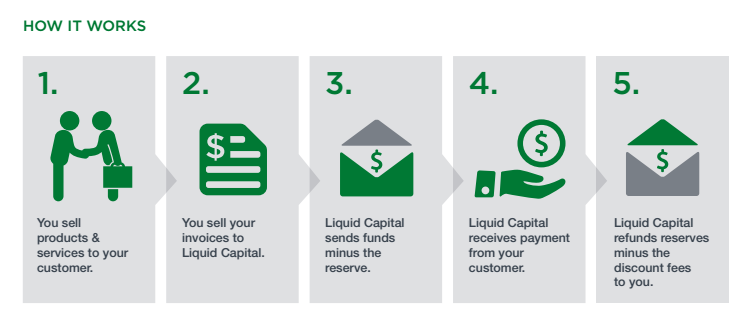
If you’ve never heard of Accounts Receivable Factoring before, you’re not alone. But it’s been a standard financing practice in Europe and other developed nations for years. Liquid Capital specializes in it and has developed a world-class business to help you get cash in hand. Here’s how it works.

1.     You make a sale to your customer. (e.g. With a 30/60/90 term)

2.     You submit that invoice to your Liquid Capital Principal.

3.     Liquid Capital buys your invoice from you, putting cash in your business within as quickly as seven days.

a.     You’ll get 75% or more of the invoice value at this point. A reserve fund is held until step #5.

b.    At this point, the money is in your pocket and you can use it to wipe out your cash flow problems.

4.     Liquid Capital will collect from your customer on your behalf, which also alleviates strain on your internal A/R department.

5.     When the customer finally pays, Liquid Capital will refund you any additional reserve funds minus the discount fees.

how does factoring work - cash flow solution

This process can fast-track your cash cycle by anywhere from three weeks to three months or more! With faster access to working capital, you’ll be able to fulfill orders, take advantage of supplier discounts and pay your employees faster and more efficiently.


A Long-Term Cash Flow Solution 

Liquid Capital is a market leader and works with you as a trusted partner, not as a one-time lender. We have over 80 trained Principals across North America who are business owners themselves, and they each work directly with clients to develop business relationships, face-to-face whenever possible.

A Liquid Capital factoring solution can give you cash up front for your sales, helps you spend less time and employee expenses on collections, and ultimately helps you graduate to a traditional bank loan option. The factoring process is so beneficial that many clients will choose to work with us alongside their banks for various financing options, depending on their needs.

We know that growth-oriented B2B owners don’t wake up in the morning thinking fondly about collecting on their accounts receivable. So as a business partner, we lighten your worries through financing solutions that put cash in your pocket. And better yet, it will help you get a good night’s sleep.


Manufacturing and banking illustration

Factoring & Purchase Order Financing Combine To Build A Distributor’s Business

manufacturing

When a Canadian distributor for a European manufacturer of innovative ground screws needed funding for large orders they turned to Greg Norris at Liquid Capital in Toronto and Mark Polinsky of Gateway Trade Funding near Chicago.

The distributor’s products are used in construction to establish a foundation in virtually any terrain. As an alternative to concrete slab foundations, the ground screws allow quick and stable foundations to be installed where traditional solutions may not be ideal. However, shipping the product from the Czech Republic meant that there was a considerable lag time between when payment to the manufacturer was due and when the distributor could collect from the purchaser.

Traditional bank financing was not available because of a number of hurdles including international currency conversions, the innovative and non-traditional nature of the product and the involvement of somewhat risky construction projects.

Funding the transaction

Norris was able to structure a solution involving purchase order financing and factoring that worked well for the distributor, allowing them to create the cash flow needed to complete transactions for customers in both the US and Canada.

“This solution was not without several challenges,” said Norris. “Working with multiple players in multiple countries and funding the significant transportation time all complicated the transactions. Working with Gateway Trade Funding outside Chicago, we were able to fund this and then manage all of the logistics and needs of each participant.”

Funding these transactions is expected to exceed $2.5 million (USD). “The financing solution allows this particular distributor to capture business they would not otherwise be able to transact,” said Polinsky. “It’s helping them to grow their business while introducing innovative solutions to their customers.”

How your business can do the same

Liquid Capital may be able to offer your business purchase order financing and factoring similar to this case. If you’ve been denied traditional bank loans because of issues like international currency conversions or what the banks deem as a risky project, then there is another option with Liquid Capital.

Ready for help? Turn your open invoices into working capital with Liquid Capital’s Accounts Receivable Factoring Solution.